|
Building Spiritual Leaders Copyright © 2002-2003 by M. W. Andrews; all rights reserved. This material may be used and distributed freely as long Last revision: 7 July 2003 |
|
A Foundation for Leadership |
|
||
|
Choose Dependable Leaders |
|
||
|
The Power of Example |
|
||
|
The Power of Followership |
|||
|
|
The Power of Caring |
|
|
|
|
|
|
|
|
The Essence of Leadership |
|||
|
Spiritual Followership |
|
||
|
Spiritual Leadership |
|||
|
We Are All Examples |
|||
|
We Are All Responsible (Part 1) |
|
||
|
We Are All Responsible (Part 2) |
|
||
|
|
|
|
|
|
The Needs of a Leader |
|
||
|
The Work of a Leader |
|||
|
The Integrity of a Leader |
|
||
|
The Charge to Leaders |
|
Explanation of style
|
Titus 1:1-4 Red text Blue text Various symbols (some of these
|
There is an abundance of questions and information provided in this study guide more, in fact, than will fit in typical class periods. The purpose of this excess is to provide the teacher with options that best suit the needs and direction of the class. The teacher can trim the material to correspond with the desired length of the class and the interests of the group. Since the colored text helps identify elements that lead to the main themes, the colors can be used as a guide for what to include. Scriptures along the left margin should be read in class before proceeding with the questions and comments. Parentheses indicate that the reading is optional. Major points to emphasize A portion of the questions that emphasize the main themes. These could be distributed before class to help class members prepare their thoughts. [1] Endnote reference; click on the number to see the reference. Ñ Key point of explanation or interpretation s Question to ask your discussion group; possible answers or considerations sometimes follow in a list below the question. © Application question useful for going deeper into each persons walk with Christ. ( Quote that helps amplify the point or help class members think about it. @ Historical reference. þ Relevant map with link to click on. µ Relevant photo with link to click on. Relevant art work with link to click on. ¥ Text slide with link to click on. A box with an arrow points to a question (and possible answers) that could be listed on a flipchart or similar tool. This format encourages class members to share more of their thoughts about the question. A box (without an arrow) containing text represents a fundamental principle in the lesson that should be written or projected where all students can see it. This helps them retain the central message while other supporting points are being discussed. |
|
Acts 20:17-38 |
Ñ The timeframe for these letters has been a subject of much debate. Titus and 1 Timothy were written during a mission journey, and the most likely choices for the date are the following: [1] a) Around the time that Paul visited Ephesus and was driven away by the excitement caused by Demetrius (Acts 20:1) about 58-59 A.D. This view assumes that Paul correctly knew that he would never see Ephesus again (Acts 20:25) and was martyred around A.D. 62-64. b)
After his imprisonment at Rome (following
all of the events described in Acts) |
|
|
|
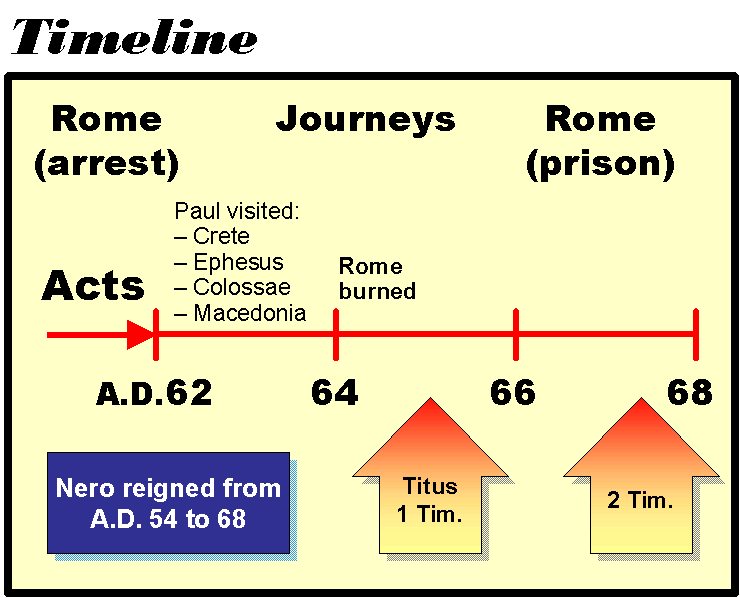
Ñ According to the historian Eusebius, Paul was released from house-arrest in Rome (described at the end of Acts) after two years (around A.D. 62-63) and again journeyed on the ministry of preaching.[2] Among the places Paul visited were Crete, where he left Titus, and Ephesus, where he left Timothy. He may well have gone on to Colossae to see Philemon, as he had planned, |
|
|
|
and he certainly reached Macedonia. Sometime during this period Paul may have even traveled as far west as Spain.[3] Ñ It was from Macedonia (sometime during A.D. 62-66) that he wrote to Titus and to Timothy. Paul instructed Titus to establish solid leadership in the churches in Crete. He wrote to Timothy to help him meet the problems being faced in the church, and he wanted to encourage the young ministers growth and leadership.[4] Ñ Paul told Titus that he planned to winter in Nicopolis (a town on the west coast of Greece). Presumably he did this, and also revisited Timothy in Ephesus. Then he probably visited nearby Miletus, where he left Trophimus behind ill, and then traveled on to Troas and stayed with Carpus, with whom he left his cloak and some books. Then he went to Corinth, where Erastus remained when Paul left for Rome. It may have been somewhere between Troas and Corinth that Paul was again arrested, but in any case he traveled on to Rome and was placed in prison.[5] |
|
|
|
Ñ Several years elapsed between Pauls first imprisonment (Acts 28), and his martyrdom, which was no later than A.D. 68 (the last year of Nero's reign).[6] Rome burned in A.D. 64 and many Christians were arrested and blamed for it. Nero traveled through Greece during A.D. 66-68 and Paul may have been arrested at that time and sent to a Roman prison. Nero himself was not in Rome at this time, and his bloodthirsty delegates (Helius and Tigellinus) may have been responsible for Pauls martyrdom.[7] Shortly before he died, Paul wrote his second letter to Timothy. Pauls intent was to equip his close companion for the journey ahead after Paul was gone. |
|
|
Titus |
|
|
Ñ Paul is writing this letter to one of his closest companions (the same is true for Timothy). He wants Titus (and Timothy) to understand how to be effective among the churches. The instruction he provides them would make an excellent graduate class in leadership not Leadership 101, because that would only be the basic management theories that the world has defined. This is at least Leadership 201, because Paul helps his readers understand much more than goal-setting and delegation. In these letters Paul reveals the heart of a leader. |
|
|
|
Titus 1:1-4 |
s Why had Paul become Gods servant? - For the faith of the people God had chosen - For the knowledge of the truth that leads to godliness - In hope of eternal life, promised by God, upon which both faith & knowledge rest - It was Gods appointed time to entrust the message to Paul s What had been entrusted to Paul? s What is Pauls relationship with Titus? s
What does it mean to be someones son in a common faith? |
|
|
|
|
s Who are your spiritual children? s Who are your spiritual parents? Ñ Paul introduces us here to the first fundamental truth about leadership. Every Christian is both a child and a parent both a follower and a leader both a Timothy and a Paul. |
|
|
|
s What was the assignment that Paul gave Titus? - In this letter Paul instructs Titus to appoint (recognize, set up) elders - Titus is in Crete, the largest island in the Mediterranean Sea |
|||
|
|
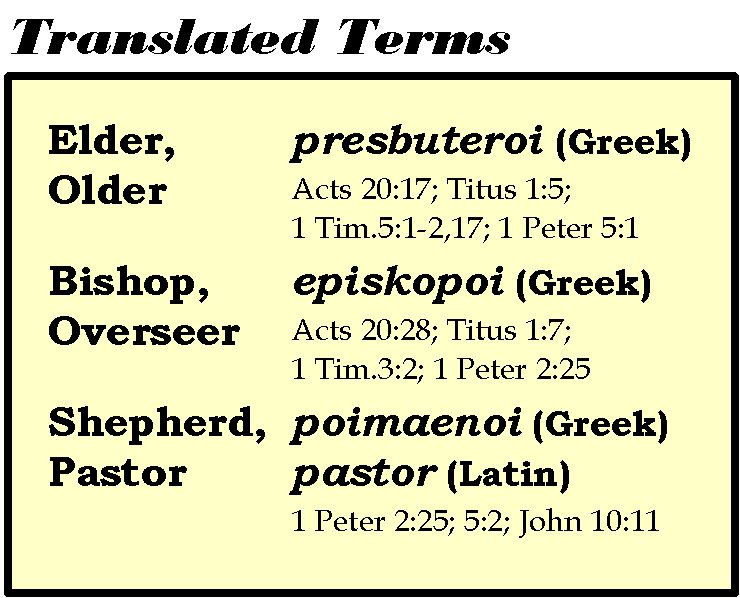
s What is an elder (v.5)? - Elders simply means older or experienced leaders.[8] - Cultural anthropologists tell us that almost every society has had elders of some kind. Whether they be tribal chieftains, village headmen, clan leaders, or family patriarchs most every social unit across history and around the globe has clearly recognized adult role models or wisdom figures.[9] s What is an overseer or bishop (v.7)? |
||
|
|
- Guides, caretakers, leaders, or those who watch on behalf of[10] - A form of this same word is also used in James 1:27. s
What two denominations have names that correspond to the Greek words? - Presbyterian - Episcopal Ñ In Acts20 and 1 Pet.5:1-4, a metaphorical term is added to these: shepherd (poimaenoi). The English term pastor is a translation of this same word. s What are the main roles of elders (bishops)? |
||
|
|
Ñ Read Acts 14:5-7, 21-23 and discuss how much time Paul allowed in this new congregation before appointing elders. Do you think that Paul appointed men who were already spiritual leaders or that some men grew into spiritual leaders this quickly? |
||

|
|
|
Titus 1:5-9 |
Godly Leaders Love What Is Good s What kind of person should an elder be? s The basic descriptions are given in v.6. What is the significance of each? - Above reproach (v.6) - Husband of one wife (v.6) - Having faithful children (v.6) literally trustworthy or trusting, not necessarily specifying faithfulness to Christ - Children are not accused of dissipation (wildness) or rebellion (disobedience) (v.6) (
Paul believes a mans ability to
build and maintain healthy relationships in his home provides evidence that
he can do so in a church. [11] s Paul goes on to explain why these characteristics are necessary and some further details about what he meant. Discuss what each of the following mean and why its important: - Gods steward (manager) (v.7) - Not self-willed (not over-bearing) (v.7) - Not quick-tempered (v.7) - Not addicted to wine (v.7) - Not pugnacious (violent) (v.7) - Not pursuing dishonest income (v.7) - Hospitable (v.8) - Loving what is good (v.8) - Sensible (self-controlled) (v.8) - Just (upright, righteous, virtuous) (v.8) - Devout (holy, pure, free from wickedness) (v.8) - Self-controlled (disciplined, exercising restraint) (v.8) - Holds firmly to sound teaching (v.8) - Able to exhort and refute (v.8) s How should this list be used to identify elders? How has it been used? Ñ Paul would likely be shocked to see his material used as a checklist. Rather, it was a common literary style to present a general character sketch.[12] Two examples are Diogenes Laertius description of the stoics concept of a good man (7:116-126) and Onosanders summary of the character of an ideal commander: [13]
|
|
|
Diogenes Laertius: Good Stoic Onosander: Ideal Commander Married Prudent Without pride Self-controlled Temperate Sober Combine prudence of
mind Frugal Intelligent Without love of money Neither young nor old Father of a family (if possible) Able to speak competently Good reputation Ñ When Paul used this literary form, he did not intend to provide a complete and absolute list of qualifications. He simply gave a broad yet instructive sketch of their expected character. This is why the list in 1 Tim.3 is not identical to the list in Titus 1. If Pauls intention had been to create a checklist, then surely he would have made them the same. Comparison of Attributes Titus 1 1 Timothy 3 Above reproach (v.6) Above reproach (v.2) Husband of one wife (v.6) Husband of one wife (v.2) Having faithful children (v.6) Manages family well (v.4) Children not wild or rebellious (v.6) Children obey with respect (v.4) Gods steward (v.7) Not self-willed (v.7) Temperate (v.2) Not quick-tempered (v.7) Not quarrelsome (v.3) Not addicted to wine (v.7) Not given to much wine (v.3) Not violent (v.7) Not violent, but gentle (v.3) Not pursuing dishonest income (v.7) Not a lover of money (v.3) Hospitable (v.8) Hospitable (v.2) Loving what is good (v.8) Sensible (self-controlled) (v.8) Self-controlled (sound mind) (v.2) Just (upright, righteous, virtuous) (v.8) Devout (holy, pure) (v.8) Self-controlled (disciplined) (v.8) Holds firmly to sound teaching (v.8) Able to exhort and refute (v.8) Able to teach (v.2) Respectable (modest) (v.2) Not a recent convert (v.6) Good reputation with outsiders (v.7) Ñ Notice also that there is no mention of spiritual gifts in this passage (cf. Rom.12:6-8; 1 Cor.12:7-11; Eph.4:11; 1 Pet.4:10-11). These characteristics describe spiritual maturity and do not suddenly appear in anyone. It takes time to become like Jesus, and our stage in the process is discernable by ourselves and by those who associate with us.[14] |
|
|
Deceitful Leaders Love What Is Corrupt s Why do the elders in Crete need to be able to be rooted in sound doctrine? Ñ Paul explains that negative behaviors (the opposite of those in v.6-9) abound in society, and Titus must be careful to avoid relying upon such people as spiritual leaders. We taught
him to steal, and the first thing he did was to try it on us. [15] s What can you gather from this passage about the message of these false teachers? - Included circumcision - Involved Jewish myths - Claimed to know God, but didnt walk the talk - Upset families - Swindled people (dishonest gain) |
|
|
( The moment I do anything in order to appear better or stronger than I really am no matter how small it may seem I have begun a deadly deception, and I set myself up for bigger and more horrendous things to come. [16] Lynn Anderson s Are there people today who use religion in order to deceive people for their own gain? Ñ Paul claims that these deceivers need to be silenced. The word he uses in Greek means to bridle or muzzle.[17] s
Isnt Paul impinging upon the rights of these talkers? s
How is a person reproved? Ñ
The prophet of their own was probably Epimenides, a poet who
was born in Crete at Cnossos. Epimenides wrote this saying in a hexameter
line and Callimachus quoted it in a Hymn to Zeus. Epimenides is thought by
some to be the one who suggested to the Athenians the erection of statues to
unknown gods (Acts 17:23).[18] s
What do you think Paul meant in v.15? - Even when engaged in godly activities, these teachers cant achieve godly results. s How can a Christian live in the midst of the kinds of deceit that Paul describes and not be tainted by it? Ñ Notice that Paul provides two lists of qualities in this chapter: one for godly leaders and one for deceitful leaders. His primary point appears to be this contrast rather than establishing a detailed set of criteria. |

|
|
ÿ Spiritual leadership begins at home ÿ Spiritual leaders live in the midst of deceit without being tainted by it. |
|
Titus 2:1-10 |
The Source of Power for Others s What are the groups of people that Paul wants Titus to teach properly? - Older men temperate, respectable, self-controlled, faithful, loving, enduring - Older women reverent, not slanderers, not addicted to wine, teaching others - Young men self-controlled - Slaves obedient, trustworthy, good example s
Is there a difference between the
elders in 2:2-3 and the elders in 1:5? Ñ The same Greek word is used in 2:3 it is the feminine presbutis. s How are the characteristics in 2:2-3 similar to those in chapter 1? s How would the behavior of these older men and women affect the lives of younger people (v.4-6)? s How would Titus example affect other people (v.7-8)? (
We teach what we know; we reproduce what we are. [19] s
What sort of behavior does Paul recommend for slaves? |
|
|
( [Paul] made decision makers out of those who were forbidden to make decisions. [20] Richard Foster s
How would the slaves example affect
others? - They are a visual testament to the character of God ( Example is not the main thing in influencing others it is the only thing. [21] Albert Schweitzer (1875-1965) ( Shepherding sheep requires a long-term, costly commitment of self, time, and energy and the building of open, authentic relationships. Shepherding is no easy task. Jesus, the Chief Shepherd, exemplified this commitment in his relationship with the Twelve. for three years, they went everywhere he went. Jesus changed them by his touch. He taught them, ate with them, and protected them. He talked with them until they began to hear his voice way down in their souls. Eventually, people could tell by being around them that they had been with Jesus. [22] Lynn Anderson |
|
|
The Source of Power for Us s What are some gifts from God for which Paul is grateful? - Gods grace - Salvation - Instruction about how to live - The blessed hope - The promise of the appearing of Jesus glory |
|
|
s What are some things that Christ has done in order for us to be able to share Gods character? - Gave Himself as our Savior - Redeemed us from every lawless deed - Purified us as His own to be zealous for good deeds Ñ Paul makes it clear that people dont adopt behavior like this just because they innately desire it. It is an expression of gratitude for Gods grace, and it is an empowering by God through His act of redemption. Ñ Paul has spent this entire chapter emphasizing the power of example. But that example doesnt happen because we want it. It happens because God wants it and were willing to let Him have His way. |

|
|
|
|
s
What are three ways in which Titus is
to convey this message (v.15)? - Speak (teach) - Exhort (encourage) - Reprove (rebuke) s At this point in his letter, whom is Paul directing Titus to instruct? Everyone? s
How are we supposed to behave with
respect to authority? ( Most of us, rather than being critical of our leaders would be better served by learning to be and do what we expect our leaders to be and do. [23] Lynn Anderson s What are some of the motivations presented by Paul that cause us to want to pursue good behaviors? - We recognize that the negative behaviors were foolish (v.3). - We are grateful that God has saved us (v.4-7). - Believers are expected to perform good deeds (v.8). - These behaviors are beneficial (v.8-9). s What is the trustworthy statement? - Its in v.5-7. |
|
|
Credit to whom credit is due Ø God saved us because He is merciful Ø God washed us and renewed us because He is generous Ø God gave us eternal life because He is gracious |
|
|
s
Paul wants Titus to speak confidently about this principle
(v.8). s Why are debates and genealogies unprofitable (v.9)? s
What does it mean to reject someone? |
|
Titus 3:12-15 |
s What final instructions does Paul give to Titus? - Come to Nicopolis. Why? - Help Zenas and Apollos. Why? - Help people learn to meet needs. Why? s
Why do you suppose Paul didnt tell
Titus to meet those pressing needs himself? - Those in need may suffer. - Others may recognize the need and begin to help. Ñ Paul ends this letter with a group of supporters around him, encouraged by their presence. |

|
|
|
|
1 Timothy |
|
1 Tim 1:1-2 |
s What are Pauls credentials? s What is Pauls relationship with Timothy? s If someone wrote this greeting to you, what would you appreciate about it? |
|
|
The Problem s What are some things that Paul says people become obsessed with? - False doctrines - Myths - Genealogies - Meaningless talk - Teaching things without understanding them s How are these pursuits different from the way of faith (v.4)? s What was Pauls agenda what motivated him to confront these behaviors (v.5)? - Love ( You must decide whether or not you will design your life after the pattern of Jesus, or design your life around the best thinking the world has to offer. [24] C. Gene Wilkes |
|
|
The Antidote s What does Paul say that the source of love is (v.5)? - Pure heart - Good conscience - Sincere faith s How do these contribute to love? s What happens when people want to teach more than they want to love? Ñ Love is even more important than doctrine, because the good news is all about love. Without love, the doctrine will always fall short (1 Cor. 13). s What is the purpose of the law (v.8-11)? |
|
1 Tim 1:12-17 |
Counted Among the Faithful s What had Christ given to Paul (i.e., what is he thankful for)? - Strength - Appointment to service - Mercy - Grace - Faith - Love s Compare Pauls attitude with the attitude of those who wanted to be teachers. How is Paul different? (
It seems to me that we often, almost sulkily, reject the
good that God offers us because, at the moment, we expected some other good.
[25] Ñ
The people described in 1:3-7 are devisive,
worldly leaders. s What is the trustworthy statement (v.15)? |
|
|
Christ Jesus came into the world to save sinners |
|
|
s Why did Christ come into the world (v.15)? - Christ is the salvation. - Therefore, spiritual leaders let Jesus be Savior and Lord s Why did the Lord save Paul (v.16)? s What is the significance of each of these attributes of God (v.17)? - Eternal - Immortal - Invisible - Only (unique) |
|
1 Tim 1:18-20 |
Staying Among the Faithful Ñ This is the beginning of Pauls instructions to Timothy. s
What prophesies might have been made
about Timothy? By whom? Why? - Strength for the fight |
|
s
Here is a story about two men who
destroyed their faith (Hymenaeus and Alexander). How did it happen? |

|
|
|
|
Ñ Paul has already explained that Christ came into the world to show mercy and to save sinners (1:15) now Paul states that we should behave similarly. |
|
|
Respecting Worldly Leadership s What are we expected to do for our leaders? - Make requests on their behalf - Pray for them - Intercede for them - Be thankful for them s Why are we supposed to behave in this manner? - So that we can focus on the Lord without unnecessary distraction (v.2) - So that they too might be saved (v.4) |
|
1 Tim 2:5-7 |
Respecting Heavenly Leadership s
How does Jesus act as mediator
(v.5)? Ñ It is precisely because God wants everyone to be saved that Paul was made an apostle, so that everyone (including Gentiles) could hear the truth. |
|
1 Tim 2:8-15 |
The Key Ingredient: Submission s Why is submission important among Christians? s What are some examples of submissive behavior that Paul recommends? s
What attitude should men have
(v.8)? s What does it mean to have holy hands (v.8)? (
Here is an example of what our attitude is usually like: s What attitude should women have (v.9-15)? s
Why was their manner of dress important (v.9-10)? s
Why was their manner of learning important (v.11)? s
What does it mean to learn in quietness and to be silent
(v.11-12)? Ñ The meaning of having authority (v.12) is to take command without permission. Just as men are told to not dispute, women are told to not grasp at authority. Notice that v.9 begins, likewise (i.e., just like the men). s What qualities should women exhibit? - Faith - Love - Holiness - Propriety s
- Each woman who bears a child is protected during birth - Women in general are protected during childbirth - Childbirth is a submissive action that contributes to an individuals salvation - Childbirth is a submissive action that collectively helps womankind to be saved - Childbearing is the means by which our Salvation (Jesus) came into the world |
|
|
Ñ In Gods kingdom, submission is a leadership quality; our difficulty with such a concept is the result of our association with the worlds view of leadership. ( The first question for aspiring spiritual leaders is not, Am I a shepherd? but Am I a sheep? [27] Lynn Anderson |

|
|
|
1 Tim 3:1-7 |
Bishops (Overseers) s What is the trustworthy saying (v.1)? |
|
|
|
If anyone sets his heart on being an overseer, he desires a noble task |
|
|
|
s What is an overseer or bishop (episkopos)? - guardian, custodian, or guide. Ñ Notice that Paul refers to it as a task, not a position. The phrase in v.1 could be accurately translated, if anyone desires to bishop [28] |
|
|
|
s Why is it a noble task or fine work? s What kind of person should an overseer be? s How is the function of an overseer like that of a shepherd (Acts20:28, 1 Peter 5:2)? - Shepherds feed, nourish, and tend the flock (notice how the same word, poimainoo, is used in John 21:16) - Overseers watch out for the flock |
|
|
|
s How is this type of leader different from worldly leaders? - Hired hands (John 10) care about their purse more than the flock - Cowboys drive the herd, while shepherds lead [29] - Policemen and judges rely upon the law - Monarchs rely upon position - Political leaders rely upon popular whim and majority opinion - Pop star entertainers (incl. movie sports stars) seldom have guiding principles - Generals and CEOs dispatch policies from behind closed doors ( Lynn Anderson tells a story about a tour guide who explained to his group that shepherds dont drive sheep. Shortly afterwards the group noticed a man chasing several sheep and hitting them. Disappointed the his group saw such an example, the tour guide sought out the man, only to discover that he was a butcher, not a shepherd. [30] |
|
|
|
s Discuss what each of the following mean and why its important: - Above reproach (v.2) - Husband of one wife (v.2) - Temperate (v.2) - Self-controlled (v.2) - Respectable (v.2) - Hospitable (v.2) - Able to teach (v.2) - Not given to much wine (v.3) - Not violent, but gentle (v.3) - Not quarrelsome (v.3) - Not a lover of money (v.3) - Manages family well (v.4-5) - Not a recent convert (v.6) - Good reputation with outsiders (v.7) s
Which characteristic of an elder is most important to you? s Suppose you face a major decision marriage, business, career and you need guidance as you weigh your options. Perhaps a parenting challenge has pushed you beyond desperation or an important relationship isnt working. Maybe your business is going down the tubes or your marriage is in deep trouble. Or perhaps the doctor has just told you that you have a life-threatening illness, or maybe your faith is on the rocks or some other biggie has you in moral straits and sorely in need of safe and wise spiritual counsel. Where will you turn for help? Who are you most likely to turn to when your back hits the wall? What specific names come to mind? Who are the first three people you think of? Why them? It is because they exhibit to you what an elder is. An elder has the experience, character, and vision to guide, comfort, and advise the sheep of his flock.[31] ( The list in Titus 1 is not the same as in this passage. The differences between these lists may reflect differences in the needs of these two congregations (i.e., Crete and Ephesus). Dr. Carroll Osborne, a native of rural Arkansas, observed that an elder in the Black River bottoms of Arkansas would not likely command much respect unless he owned high-class coon dogs. If a man didnt have enough sense to know good dogs, how could he possibly have enough sense to lead a church? [32] |
|
|
Comparison of Attributes 1 Timothy 3 Titus 1 Above reproach (v.2) Above reproach (v.6) Husband of one wife (v.2) Husband of one wife (v.6) Temperate (v.2) Not self-willed (v.7) Self-controlled (sound mind) (v.2) Sensible (self-controlled) (v.8) Respectable (modest) (v.2) Hospitable (v.2) Hospitable (v.8) Able to teach (v.2) Able to exhort and refute (v.8) Not given to much wine (v.3) Not addicted to wine (v.7) Not violent, but gentle (v.3) Not violent (v.7) Not quarrelsome (v.3) Not quick-tempered (v.7) Not a lover of money (v.3) Not pursuing dishonest income (v.7) Manages family well (v.4) Having faithful children (v.6) Children obey with respect (v.4) Children not wild or rebellious (v.6) Not a recent convert (v.6) Good reputation with outsiders (v.7) Gods steward (v.7) Loving what is good (v.8) Just (upright, righteous, virtuous) (v.8) Devout (holy, pure) (v.8) Self-controlled (disciplined) (v.8) Holds firmly to sound teaching (v.8) |
|
1 Tim 3:8-13 |
Deacons s
What is a deacon? |
|
|
s Why are characteristics described for both men and women? s Discuss what each of the following mean and why its important: Men - Worthy of respect (v.8) - Sincere (v.8) - Not indulging in much wine (v.8) - Not pursuing dishonest gain (v.8) - Hold onto deep truths (v.9) - Clear conscience (v.9) - Successfully tested (v.10) - Husband of one wife (v.12) - Manage family well (v.12) Women - Worthy of respect (v.11) - Not malicious talkers (v.11) - Temperate (v.11) - Trustworthy (v.11) s How do these characteristics make a man a better servant? s How do these characteristics make a woman a better servant? |
|
|
Ñ In Romans 16:1, a woman named Phoebe is described using the same word that is used here in v.11. It literally means a female servant. There is no indication that these women were the deacons wives, but even if they were, they are specifically encouraged to be examples of servanthood. s
What are the rewards of being a deacon
(v.13)? |
|
1 Tim 3:14-16 |
Godliness For All Servants s Why was Paul sending these instructions for overseers and deacons? s What is the household of God (v.15)? Ñ Although Timothy may be appointing some bishops and deacons (this was the reason for instructions to Titus), the purpose of this summary doesnt seem to be for election criteria. Paul wants the chosen servants to know how they should behave (v.15). |
|
|
s Why is the specific behavior of bishops and deacons so important? s What are some terms used here to describe the church (v.15)? - Gods household - Church of the living God - Pillar and foundation of the truth s What can you learn about Jesus from Pauls anthem in v.16? Ñ Paul is caught up in the wonder that God would reveal His Son to the world through us, His church. And our conduct is the witness that we convey. Do you think your behavior as a Christian doesnt matter? It may affect whether others commit themselves to the Lord. God determined in His great wisdom to show His power in ordinary people like you and me. |

|
|
ÿ Spiritual leaders desire the task (rather than the position) of leadership. |
|
|
Rules s The Jewish Christians believed they were living in the end of one age and the beginning of the next. Paul was saying that what was happening in Ephesus (1:3-4,19-20) had been foreseen. s What should Christians look out for? - People following other spirits (v.1) - Seared consciences (v.2) - Restrictions on marriage and food (v.3) s Do you observe any of these happening today? s
Do Christians impose regulations on food
or relationships today? - What about drinking alcohol? - What about eating blood? - What about marriage restrictions for divorced people? (
Man is a creature that is led more by patterns than by
precepts. [33] |
|
1 Tim 4:6-16 |
Practice s What is the trustworthy saying? - NIV suggests it is in v.10, but NASV suggests it is in v.8. - Most commentators (e.g., Peterson, Wuest, Barclay) go with v.8 - That means that v.10 is an amplification of the principle. |
|
|
Spiritual discipline offers great promise both now and in the future. |
|
|
s
How does one train for
godliness? s What are the benefits of godliness training? - What promise does it have for the present life? - What promise does it have for the life to come? s How could we improve our own training? - Paul uses athletic terms to explain that it is strenuous work. ( Always do right. This will surprise some people and astonish the rest. [34] Mark Twain (1835-1910) |
|
|
s God is certainly the Savior of those who believe, but Paul says He is also the Savior of everyone else (v.10). What does he mean? s
What are some ways that Paul wants
Timothy to set an example (v.11)? ( For the watching world, we ourselves serve proof that God is alive. We form the visible shape of what he is like. [35] Philip Yancey s Is Paul describing church worship or daily life? s How was Timothy given a gift? By whom? (Compare with 2 Tim.1:6) s Can you speculate what Timothys gift might have been? s
What role does Timothy have in saving
others (v.16)? |

|
|
ÿ Spiritual leaders train in godliness |
|
1 Tim 5:1-16 |
Responsible for Honoring Family s Do you think that this instruction (v.1-2) is for Timothy himself or for all Christians? Why? s How would you say that Paul wants us to treat each other? - As family s What are some ways we should provide for those who are in need? - Caring for parents and grandparents - Prayer - Provide for relatives (esp. immediate family) - Encourage young widows to remarry |
|
|
s Which widows should the church provide for (v.9-10)? Do we do this? s Are we better off today with insurance and social security, or have we lost something important? |
|
1 Tim 5:17-20 |
Responsible for Honoring Leaders s Are elders the same as bishops (3:1)? Ñ Elders (presbuteroi) simply means older or leaders. [37] Ñ Read 5:17 in several Bible versions. Some translations refer to the way that elders rule, but this Greek word (proistates) is also used in 1 Tim 3:4,5,12 to describe managing or leading a family. A derivative of this word (prostatis) depicts Phoebe (Romans 16:2) as an aid and guardian. The term expresses compassionate leadership more than authoritative power. ( When a person needs to assert his authority, it usually means he has very little of it. [38] Lawrence Anderson Ñ Notice how Lk.22:25-26 contrasts authoritarian leadership with servant leadership. The precise words that the Greeks routinely used for authority (exousia) and power (timee) are not used in the New Testament to describe elders. There is another Greek word for leader (eegoumenois) which carries some meaning of authority, and it is used in general discussion about leaders (Heb.13:17 and 1 Thes.5:12-13). [39] s What are some ways that elders are to be treated? - Monetary support (instead of requiring them to spend their time making a living) - Dont allow accusations (without witnesses) - Publicly rebuke those who sin. Why? Because they are an example that others follow. |
|
|
Ñ In another passage (1 Cor.9:7-14) Paul recommended paying those who preach the gospel, but here he suggests paying elders. s Do we treat elders in this manner? What are our reasons? (
The elders heart and character determine the length of
his tenure. [40] |
|
1 Tim 5:21-25 |
Responsible for Doing What is Right s How might Timothy be tempted to show partiality or favoritism (v.21)? Ñ A decade ago the employee policy manual of a large church in the Southwest required that Staff ministers of the church shall not form their personal friendships from within the congregation. [41] Is this what Paul meant by avoiding any accusations of favoritism? |
|
|
Ñ Regarding the laying on of hands (v.22), Timothy had received this himself when he was given his gift (4:14). This was a special event, not to be administered lightly. Apparently people needed to be prepared for the responsibility, or it might cause them to sin. So in addition to discouraging negative results (i.e., sin), Timothy needed to also be cautious about promoting positive results (i.e., gifts). s
What do you think about Pauls
medical prescription in v.23? s What causes some sins to be more obvious than others? s If these actions are obvious, why did Timothy need this instruction? s How is our treatment of people swayed by appearances? |

|
|
ÿ Spiritual leaders behave generously and responsibly toward people. |
|
1 Tim 6:1-2 |
Responsible for Respecting Those in Power s If you were a slave, how would you understand Pauls message for you? s Why doesnt Paul use the common faith as an opportunity to free slaves? |
|
1 Tim 6:3-10 |
Responsible for Being Godly s Are there any doctrinal controversies that you think are unhealthy for us (v.4)? What are some examples? s
Why does wealth often cause problems
(v.9-10)? s
How is godliness with contentment
more fulfilling than wealth (v.6)? |
1 Tim 6:11-16 |
Responsible for Being Faithful s How are these characteristics (v.11) different from what the world teaches us to be? s How is faith like a fight (v.12)? s What are some ways that you can take hold of eternal life (v.12)? s
What is the good confession
(v.12-13)? s What are some ways that Paul describes God in v.15-16? - Blessed and only Ruler - King of kings and Lord of lords - He alone is immortal - Lives in unapproachable light - No one has seen or can see Him |
|
|
Ñ Paul includes a brief epilogue to emphasize his main concerns. s What are the points he wants Timothy (and others) to remember? - Put your hope in God, not in wealth -
Do good; be generous - Be responsible with what youve been given -
Avoid useless talk and
false knowledge |

|
|
|
|
2 Timothy |
|
2 Tim 1:1-11 |
Those Who Are Called s What can you learn about Timothy from this passage? - Close relationship with Paul (son) - Sincere faith (v.5) - Faithful mother & grandmother (v.5) - He needed encouragement (v.7) Ñ Again, Paul calls Timothy his son (recall 1 Tim.1:2) The closeness of their relationship is indicated by Pauls emotions (tears in v.4). s
Describe Timothys heritage of faith. s
How had Timothy received his gift
(v.6)? s
Whats wrong with being timid or
fearful? (see Mark 4:40-41; Rev.21:8) - By joining in (v.8) s Describe the nature of the spirit that we have been given in Christ (v.7). - Power - Love - Discipline What is the role of our spirit in these? - Our spirit is like this because weve been given Gods Spirit s
What might Timothy become ashamed of
(v.8)? s
What is the calling that Paul
mentions in v.9? |
|
|
Ñ Notice that this calling is not according to our works; i.e., it is not based on things we do but rather it is determined by Gods purpose and grace. s What are some examples of callings that are associated with grace rather than a work? Hint: such a calling would consist of something to be rather than only something to do. s What do you think your calling is? |
|
The Effect of the Calling s Do you recognize the words in v.12? - Daniel Webster Whittle (aka El Nathan) used this verse when he composed I Know Whom I Have Believed in 1883. s What are some reasons why Paul chose to endure suffering? - God saved him and called him - God revealed His purpose and grace to Paul - Appointed preacher, apostle, teacher - Paul knew Whom he believed in and trusted Him Ñ Notice the mutual trust between God and His people expressed in v.12,14. Paul entrusted his security to God, and God entrusts the Holy Spirit to us. Each gives up something to the other. s How can we make sure that the sound words we follow are based on both faith and love (v.13)? Ñ There is a delicate balance described in v.13. It is a balance that every Christian (and every church) must consider the balance between standards and relationship (or faith and love). One side focuses on the what we believe to be truth. The other side reveals the essence of our relationship with God: the intimacy that binds us close to Him. They exist in a paradox that is similar to the tension created by Gods holiness (truth) coexisting with Gods compassion (love). Every Christian and every church weighs in somewhere on this balance. s Are you more inclined to respond to what we believe or to loving relationships? What is the appropriate balance between the possible extremes? Where are we as a congregation? |
|
2 Tim 1:15-18 |
Some Rejected the Calling s What are some things that cause the trust between people and God to be broken? s Can you conjecture what might have happened to Onesiphorus? - Rejected Paul? (he had been in Rome) - Martyred? (the petition is for his household) Notice at the end of the book (4:19) that Paul greets the household of Onesiphorus, but not the man himself. |

|
|
|
|
God Gives Victory to Those Who Endure s What are some of the suggestions to Timothy that might have helped Phygelus and Hermogenes (1:15)? s What does it mean to be strong in grace (v.1)? Ñ In 1:13-14 we read that Timothy had a precious treasure entrusted to him that he should guard with the help of the Holy Spirit. That treasure consisted of sound words in a balance of love and faith. Now notice what Timothy is supposed to do with this treasure (v.2). He could have chosen to make himself indispensable, but Paul wanted him to equip others. He was told to entrust it to others who will also teach it. ( A leader who develops people, adds. A leader who develops leaders, multiplies. John Maxwell s Why did Paul want Timothy to suffer hardship with him (v.3)? s
What are the professions that Paul
uses as examples here (v.4-6)? - Soldier (focuses on the objective) - Athlete (conforms to the rules) - Farmer (works hard) s How were David and Jesus like these three examples? Ñ Pauls exhortation to remember Jesus (2:8) is similar to his statement (1:12) that he trusted Jesus. s How does Pauls suffering help others obtain salvation (2:9-10)? |
|
|
The New (Old) Rules Ø Those who give all, gain all Ø Those who finish, win Ø Those who give up, lose Ø God never gives up (ergo, God wins!) |
|
|
s What would a game with these rules be like? s How would Pauls maxim help someone who feels they have no one way out of their situation? |
|
|
God Gives Victory to Those Who Surrender s How many ways does Paul describe useless talk? - (v.14) Wrangling about words - (v.16) Worldly and empty talk -
(v.17-18) Destructive talk - (v.23) Speculation - (v.24) Quarreling |
|
|
s What are the prescriptions that Paul offers? -
(v.15) Present yourself to God (not to men). -
(v.15) Keep a straight course (handle the word of
truth accurately). -
(v.16-18) Dont just talk about it you might misuse what
you know. -
(v.19) Stay connected to the foundation. -
(v.20-21) Become a better vessel. - (v.22) Stop running after yourself (lusting) and run with others toward a worthwhile goal. -
(v.23-26) Be kind, not quarrelsome. |

|
|
ÿ Spiritual leaders let God win (and wait for the celebration). |
|
2 Tim 3:1-9 |
Powerless Religion s What do you think Paul means by the last days? s
Paul says that these are religious people (v.5),
although they deny the power of godliness. ( Sometimes pastors become pastures. The sheep feed on them and trample them, but do not follow them. [42] Mark Absher Ñ Paul describes one aspect of what we call post-modernism in v.7. We place a lot of emphasis on education and knowledge, but if people cant recognize truth it doesnt help much. Leaders have a responsibility to do more than educate people need to be connected to truth. Ñ This is the only Bible passage where Jannes and Jambres are mentioned by name. They were the names traditionally given to some of the magicians of Egypt. Read Exodus 7:10-13. s How does the behavior of Jannes and Jambres provide an example for what Paul is teaching? - They oppose truth - They are rejected - They will be found out |
|
|
Powerful Spirituality s
In what ways had Timothy imitated
Paul? - Teachings The starting point, but how many of us stop here? - Conduct Behavior that reflects our learning - Purpose A goal to direct our conduct - Faith Realization that God provides true purpose - Patience Willingness to wait on God - Love Building relationships with Gods vision - Perseverance Committing to those relationships and Gods purposes - Sufferings Enduring whatever is necessary to stay the course Ñ Paul describes an inevitable conflict that is the result of this progress: - False leaders progress to greater evils. - Godly leaders progress to greater righteousness. |
|
|
s How can Christians have both peace and suffering? s
What are the sacred writings that
Paul refers to in v.15? - To give wisdom that leads to salvation. - Useful for teaching, reproof, correction, & training. Why? to equip people. Summary Ñ
False leaders choose a form of religion to suit their own
purposes. - Remember what you were taught - Remember who taught it to you - Remember where it came from |

|
|
ÿ Spiritual leaders would rather be genuine than religious. A form of godliness is not enough. |
|
|
The Integrity Ñ In this chapter, Paul retraces his steps. Ñ Paul is serious about this charge, using legal terminology and calling upon the Father and the Son as witnesses. Notice that Paul considers Jesus as the Judge. Is this how we usually think of Jesus? Ñ Compare this admonition with 3:16 (and also with Titus 2:15): Timothys Charge (4:2) Use of Scripture (3:16) Titus 2:15 Preach (keerussoo) Teaching (didaskalia) Teach (laleoo) Reprove (elengchoo) Reproof (elegmos) Reprove (elengchoo) Rebuke (epitimaoo) Correction (epanorthoosis) Exhort (parakaleoo) Training (paideia) Exhort (parakaleoo) keerusso = herald, proclaim didaskalia = teaching, instruction laleoo = speak, utter, tell, use the voice elengchoo = convict, correct elegmos = correction, censure epitimaoo = chide, censure but also to honor epanorthoosis = correction, improvement, restoration to a right state parakaleoo = strengthen, encourage, to call to ones side paideia = complete education, training, esp. regarding virtue s What do you think Paul meant by being ready in season and out of season? When is preaching out of season (v.2)? s What are some examples that you have seen of people following someone who tells them what they want to hear (v.3-4)? s Explain what Paul wants Timothy to do (v.5). - Be sober Take it seriously - Endure hardship See it through - Work of an evangelist What is this? - Fulfill your ministry Did Timothy have a purpose? s How could we apply these four commands to ourselves? |
|
2 Tim 4:6-8 |
The Work s How does Paul view his own ministry? s How does Paul relate his own work to the three professional analogies he mentioned in 2:4-6? - Soldier (focuses on the objective) - Athlete (conforms to the rules) - Farmer (works hard) s What do you think Paul meant by loving Jesus appearing (v.1,8)? |
|
2 Tim 4:9-22 |
The Needs Ñ Paul began this letter by talking about his relationship with Timothy, and now he ends it by discussing his relationships more broadly. s Why have some left (or stayed behind)? - Loved the world (v.10) - Sent by Paul (v.10) - Illness (v.20) s Who is with Paul? - Luke - Eubulus, Pudens, Linus, Claudia, & the brethren - He wants Mark to come be with him (recall that Paul had a disagreement with him earlier Acts 15:36-41) s Why did Paul feel alone? -
Perhaps because he had to face
his trial alone (v.16-17). Ñ Paul says (v.17) that he had been delivered out of the lions mouth. He may have been figuratively saying that he was spared a death sentence, or he may literally have escaped being sent to the arena. Remember, the emperor at this time was Nero! s Do you have friends that encourage you? Ñ We began this series with Paul emphasizing his relationship with Titus and Timothy. Paul wanted them to understand that leadership is much more than goal-setting and delegation Paul reveals the heart of a leader. And now at the end of this letter (and near the end of his own life), Paul focuses on the relationships that are important. He makes it clear that we all have a role in leadership we support and encourage each other and together we reflect the risen Christ. |

|
|
|
|
s What have you learned about leadership from Pauls letters to Titus and Timothy? 1. We are all leaders, and we are all followers. 2.
Spiritual leadership begins at home. 3. Spiritual leaders are empowered by God. 4. Spiritual leaders give credit to God. 5.
Spiritual leaders lead with love. 6. Spiritual leaders first learn to follow. 7. Spiritual leaders desire the task (rather than the position) of leadership. 8. Spiritual leaders train in godliness. 9. Spiritual leaders behave generously and responsibly toward people. 10. Spiritual leaders discern what is really important. 11. Spiritual leaders have a purpose. 12. Spiritual leaders let God win (and wait for the celebration). 13. Spiritual leaders would rather be genuine than religious. 14. We all exercise spiritual leadership. s How do these letters help you be a leader? s
How do these letters help you be a follower? s What are some potential traps that we should look out for? s
Do you recall the 5 maxims (trustworthy sayings) that Paul
emphasized? 1) Titus 3:5-7 Ø God saved us because He is merciful Ø God washed us and renewed because He is generous Ø God gave us eternal life because He is gracious 2)
1 Tim 1:15 3)
1 Tim 3:1 4)
1 Tim 4:8-9 5) 2 Tim 2:11-13 Ø Those who give all, gain all Ø Those who finish, win Ø Those who give up, lose Ø God never gives up
|
References
[1] Barnes' Notes, Electronic Database. Copyright (c) 1997 by Biblesoft.
[2] Eusebius, Church History, 2.22.2.
[3] John R. W. Stott, The Message of 2 Timothy, The Bible Speaks Today Series (Downers Grove: Inter-Varsity Press, 1973), p.17.
[4] Robertson's Word Pictures in the New Testament, Electronic Database. Copyright (c) 1997 by Biblesoft & Robertson's Word Pictures in the New Testament. Copyright (c) 1985 by Broadman Press.
[5] Stott, p.17-18.
[6] Jamieson, Fausset, and Brown Commentary, Electronic Database. Copyright (c) 1997 by Biblesoft.
[7] Jack Finegan, Handbook of Biblical Chronology (Peabody, Mass: Hendrickson Publishers, 1998), p. 387, 401.
[8] Lynn Anderson, They Smell Like Sheep (West Monroe LA: Howard Publishing Co., Inc, 1997), p.128,201.
[9] Ibid., p.49.
[10] Ibid., p.129.
[11] Ibid., p.149.
[12] Ibid., p.130-131.
[13] William Barclay, The Dailey Bible Study Series: The Letters to Timothy, Titus, and Philemon (Philadelphia, The Westminster Press, 1975), p.75.
[14] Gene A. Getz, The Measure of a Man (Glendale, CA: Regal Books, 1979), p.17,19.
[15] Edythe Draper, Draper's Book of Quotations for the Christian World (Wheaton: Tyndale House Publishers, Inc., 1992). Entry 3458.
[16] Anderson, p.115.
[17] Robertson's Word Pictures in the New Testament, Electronic Database. Copyright (c) 1997 by Biblesoft & Robertson's Word Pictures in the New Testament. Copyright (c) 1985 by Broadman Press.
[18] Ibid.
[19] Robert Schmidgall, Leadership Magazine, Vol. 6, no. 2.
[20] Jill Briscoe, "Hilarious Hupotasso," Preaching Today, Tape No. 117.
[21] Draper, Entry 3431.
[22] Anderson, p.24.
[23] Ibid., p.184.
[24] Ibid., p.28.
[25] C. S. Lewis, Letters to Malcolm, Christianity Today, Vol. 31, no. 13.
[26] Paul Aiello, Jr., Leadership Magazine, Vol. 4, no. 2.
[27] Anderson, p.218.
[28] Ibid., p.189.
[29] Ibid., p.31-36.
[30] Ibid., p.29-30.
[31] Ibid., p.124-125.
[32] Ibid., p.132-133.
[33] Draper, Entry 3442.
[34] Ibid., Entry 3429.
[35] Philip Yancey, Leadership Magazine, Vol. 8, no. 3.
[36] Barclay, 1 Timothy 4:6-10.
[37] Anderson, p.201.
[38] Ibid., p.208.
[39] Anderson, p.197-201.
[40] Ibid., p.210.
[41] Ibid., p.94.
[42] Ibid., p.186.