Revealing Our Relationship with Christ

Copyright © 2003 by M. W. Andrews; all rights reserved.

This material may be used and distributed freely as long
as the copyright information is included as shown here.

Last revision: 6 July 2003


Go to Lesson 1 2 3 4 5 6 7 8 9 10 11 12 13

   Outline

Lesson

Theme

Scripture

1

Why Study This Book?

Rev 1

2

The Character of Christ

Rev 1

3

Faithfulness without Concessions

Rev 2

4

Faithfulness without Conceit

Rev 3

5

Sovereignty

Rev 4-5

6

Love in the Midst of Suffering

Rev 6-8

7

Judgment rather than Redemption

Rev 8-9

8

Redemption rather than Judgment

Rev 10-11

9

The Church and the World (1)

Rev 12-14

10

The Church and the World (1)

Rev 15-16

11

The Fall of Babylon

Rev 17-18

12

The Victory of Christ

Rev 19-20

13

God is Always Present

Rev 21-22


Indexes

Overview


Review


Extended Outline

Click on any lesson number or Scripture passage to go to that lesson.


   Brief Overview

First we are introduced to a vision of Jesus, transformed in His heavenly glory.  His appearance is similar to what was described by some of the Old Testament prophets (especially Daniel), and it visually links Jesus with God Almighty.  Before we complete even the first chapter of Revelation, we confront the Redeemer, the Firstborn of the dead, the Ruler of the kings of the earth, and surely it makes a vivid impression.

Next we are led into seven Asian congregations.  As though we were participating in a Charles Dickens novel, we are shown their works and their endurance, but also their compromise and apathy.  It is a stark contrast with the vision of Christ.  Each church is given a promise for those who overcome the world's temptations, and it is against this backdrop that the drama in the remainder of the book unfolds.  Our eyes can only see to the depth of chapters 2-3 (the condition of the churches), so Jesus helps us see the more serious spiritual conflict through a series of images.

The first spiritual reality which we are shown is God's heavenly throne room, where the Father gives Jesus a weighty assignment involving judgment.  A terrifying onslaught of suffering is unleashed as 7 seals are opened, followed by 7 trumpets of wrath and woe, and finally 7 plagues.  In the midst of it all, the church is preserved against destruction, but it is not spared from persecution.  In fact, it appears that the church is overcome by the world.  But just as Israel was delivered out of the oppressive hand of Egypt, so is the church delivered and protected.

John describes visions of terrible, powerful beasts and a proud harlot-city which threaten the saints, but the conflict is really between God and Satan.  The climax is reached with the joyous victory of the King of kings and Lord of lords.  A great city which is reminiscent of Babylon falls under its own wickedness and idolatry, but the Holy City of God emerges from the clouds in glorious splendor.  … But that's not all.  Once the harlot is removed, we can see the bride, and there's a wedding taking place – between Christ and the church.  God prepares His people through suffering for an intimate relationship.

The Lord makes His people victorious so that they can share His glory.


    Explanation of style


Joshua 1:1-9

Red text

Blue text

Various symbols

(some of these
symbols may not appear in this study)


There is an abundance of questions and information provided in this study guide – more, in fact, than will fit in typical class periods. The purpose of this “excess” is to provide the teacher with options that best suit the needs and direction of the class. The teacher can trim the material to correspond with the desired length of the class and the interests of the group. Since the colored text helps identify elements that lead to the main themes, the colors can be used as a guide for what to include.

Scriptures along the left margin should be read in class before proceeding with the questions and comments. Parentheses indicate that the reading is optional.

Major points to emphasize

A portion of the questions that emphasize the main themes. These could be distributed before class to help class members prepare their thoughts.

[1]         Endnote reference; click on the number to see the reference.

Ñ         “Key” point of explanation or interpretation

s         Question to ask your discussion group; possible answers or considerations sometimes follow in a list below the question.

©         Application question – useful for going deeper into each person’s walk with Christ.

(        Quote that helps amplify the point or help class members think about it.

@       Historical reference.

¯        Hymn that emphasizes the theme of the lesson. If your PC is equipped with a MIDI-compatible sound card, clicking on the title will play the tune.

þ      Relevant map with link to click on.

¥       Text slide.

       Relevant art work with link to click on.

A box with an arrow points to a question (and possible answers) that could be listed on a flipchart or similar tool.  This format encourages class members to share more of their thoughts about the question.


   Lesson 1


¯        He Lives                                       #346 (SFP = “Songs of Faith and Praise”)

¯        Because He Lives                           #464 (SFP)

Why Study This Book?


Ñ         No one can “teach” you the book of Revelation.  It is a book which re­quires involvement and engagement from whoever studies it.  Its purpose is to comfort, encourage, and motivate Christians, and you can­not be spoon-feed those results.  What should matter to each student is not what this book says to the teacher, but what it says to you as a student. Studies of this book often get lost in the details, but this series is intended to stay focused more on application than on exegesis.  However, it is still easy to get lost, so there is a brief overview included at the beginning. An excellent resource for this study is Breaking the Code, by Bruce Metzger, and it will be referred to often.

s         When do people get most interested in Revelation?  Why?

s         Does everyone in the world use the same calendar?
The following are some equivalents for the year “2000.”

Western (Julian) = 2000

Hebrew = 5760/5761

Islamic = 1420/1421

Chinese = 4698 (year of the dragon)

Old Roman = 2753

Coptic = 1716

Buddhist = 2544

@       There may have actually been very little concern about arrival of the year 1000 – the reports of terrors have been widely disputed.  The first recorded instance of a new century being celebrated in the Christian calendar was in 1300.  The last decade of the nineteenth century exhibited an unprecedented level of interest.  And the rapid increases in technology in the final decades of the twentieth century created a fear that the beasts of Revelation might dwell in the computers that control many day-to-day activities!  In fact, you can go to the internet and find all kinds of advice – like a “rapture index” that measures the probability of the end by counting up various events in the world. [1]

Rev 1:1-20

What is an “Apocalypse”?

Ñ         The Greek title for the book of Revelation is “apokalupsis,” which means “a revealing” or “an unveiling”.  It was not intended to conceal its mes­sage like a puzzle or mystery waiting to be deciphered, but its purpose was to enlighten and to offer its readers a new awareness. [2]

s         Why would God give a message that reveals rather than one that conceals?

s         Do you know where to find other writings which are similar to Revelation?

-         Portions of Daniel, Ezekiel, Zechariah (Zech 14:3-9), Isaiah, and Joel exhibit this style – see also Matt 24:29-31.

-         Some non-Biblical books which were written during similar times or circumstances include the book of Enoch, the Apocalypse of Baruch, the Fourth Book of Ezra, the Ascension of Isaiah, the Apocalypse of Zephaniah, the Apocalypse of Peter, the Apocalypse of Paul, Shepherd of Hermas, and parts of the Sibylline Oracles. For an example, read 1 Enoch 40. [3]

Ñ         There are several characteristics of this type of literature:

-         Visions and revelations given to the author in ecstasies or dreams.

-         Symbols which represent the nature of events, people, and principles: specific numbers (e.g., 3, 4, 7, 10, and 12) or specific features (e.g., crowns, heads, horns) or types of animals (e.g., locusts, horses, frogs, beasts) provide descriptive detail.  A good example of symbolism is found in Rev 1:4, where the Father is described in terms of His eternal nature and the Holy Spirit is described as “seven spirits”.  We are not to interpret this as seven distinct spirits, but rather as the Spirit who exhibits the essence of what “seven” represents: completeness, perfection, and godliness.

-         A terrible struggle between the forces of good and the forces of evil – the conflict culminates in the final judgment between the powers of God and Satan.

-         Predictions about the end of time or the end of the age, when evil is judged and righteousness triumphs.

-         An historical context in which there is oppression and persecution, generating an expression of longing for justice and victory.

-         A dramatic (almost theatrical) element which appeals to our senses and imagination

-         A characteristic not shared with Revelation: Pseudonymity
Sometimes the credit for authorship would be someone from antiquity.  This was to give the writing authority.  There are books attributed to Enoch, Moses, Isaiah, and others.  The real authors were not being dishonest in this practice, but simply wanted to emphasize the importance of the message. [4]  John did not use this method because Jesus Himself gives the book authority.

(        “The mode of expression is not to be confused with the message it conveys.” [5]


Ñ         There are about 250 different Old Testament passages quoted in Revelation, especially from Psalms, Isaiah, Jeremiah, Ezekiel, Daniel, and Zechariah.  There were periods in the Old Testament in which the circumstances were similar to the time when Revelation was written, so borrowing some of the images and terminology from those earlier times provided insights for Jewish readers into the reality of the first century situation.


Why did God give us such a difficult book?

s         Christ could have shown John a photo of Rome with its buildings and people, but He chose to present an image of a beast and an image of a harlot.  Which is more real and more valuable to the reader?

(        “To read Jewish and Christian apocalypses is  to enter a vivid and often confusing world of bright colors, strange animals, bizarre enumerations, and often striking images and characters of heaven and earth.” [6]


Ñ         Revelation is written as a different type of literature.  Just as we know not to confuse poetry with documentary, so we should not confuse “apocalyptic” literature with historical literature.  Its style uses imagery to convey a message – sort of like an editorial cartoonist might depict people as animals in order to make a point.  It is more like an abstract painting than like a photograph. [7]  An image which was familiar could convey a whole context.

Ñ         The purpose of the book is to help us see that God is at work and He is triumphant, no matter what appearances around us suggest.  This conflict between visible events and invisible realities would be difficult to explain in any fashion, and pictures often succeed where words fail to convey the message.  Therefore, the strange imagery of Revelation may in fact be the easiest for us to understand.

Ñ         “The apocalyptic writers were only too well aware that to describe the supernatural in words required more than formal prose; it required rather the imagery, the symbolism and the language of poetry.” [8]

Ñ         The book was written in dangerous times.[9]  Christians were being persecuted and it was going to get worse!  The message needed to be communicated in a way that the Christians would understand but that the Romans would not, thereby protecting both the writer and the readers from being accused of treason or disloyalty.

Ñ         Another reason that this book is uncomfortable is that its message causes us to confront the foundation of our faith.  Although it does little to explain our relationship with God, it does bring us into the presence of the Almighty and our beliefs about Him.  In this way, Revelation is an extremely valuable complement to the theology of Paul and the biographies of the Gospels.  While Romans guides us through an understanding of the principles of the faith, Revelation presents us with the choices and consequences inherent to a living faith.  Romans teaches us the principles of life; Revelation confronts us with the principles of life.

s         What are some ways in which Revelation confronts the reader?


Who benefits from such a book?

Ñ         Notice that John was given this message while he was “in the Spirit on the Lord’s Day” (Rev.1:10).  John was worshipful and receptive to hearing what the Lord wanted His people to hear – and this was in spite of the fact that he was exiled on the lonely island of Patmos because of his faith. John was “in Patmos” and yet he was “in the Spirit.” John himself exemplifies the basic struggle between the trials of this life and the glory in Christ.  Do we have such an attitude, and can we also say that we were “in the Spirit on the Lord’s Day”?  Perhaps this book will encourage us to be more open to the Lord for strength in our times of struggle.

s         According to 1:4, who were the recipients of this book?

-         The book was written to “the seven churches in the province of Asia” (1:4).  The specific congregations addressed in the book seem to be located on a circuit which would be traversed by someone delivering the book throughout Asia Minor, and they may have served as centers for communication with their surrounding districts. [10]  All readers are encouraged to learn from the seven letters (“He who has an ear, let him hear what the Spirit says to the churches”), and there is no indication that they were ever separated from the book as a whole.[11]  We have seven object lessons to teach us about the consequences of our own behavior.

-         In a.d.170, only about 80 years after the book was written, a list of New Testament canonical books (Muratorian Canon) included this note: “For John also, though he wrote in the Revelation to seven churches, nevertheless speaks to them all.” [12]

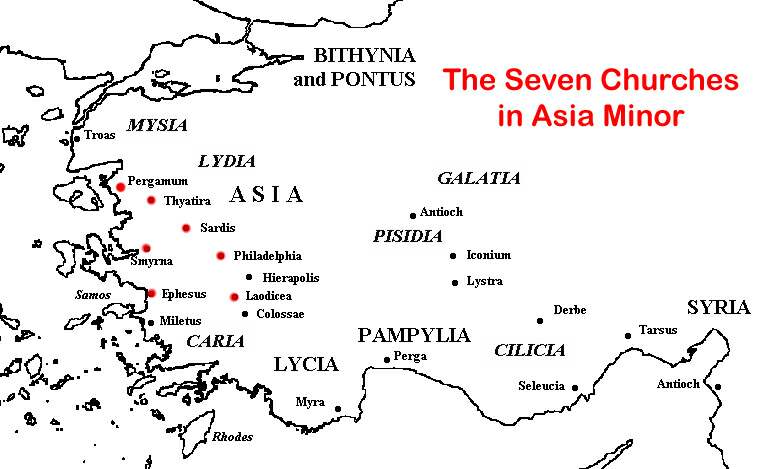
þ      Click here for a mapAsia Minor and the seven  churches


Ñ         We are told that the purpose of Revelation is to show “what must soon take place” (1:1).  That means that the message was particularly impor­tant to the first-century Christians. John makes this quite clear by including no less than eleven instances of Jesus stating that the time of His coming is near.[13]  In Rev.1:7, the action is in the “progressive present” tense, indicating that this “coming” is an activity which is already underway.[14]  Christianity had been regarded for several decades as part of the legalized Jewish religion, but as the Roman government began to perceive their separateness, the Christians found themselves in a difficult situation and were exposed to severe persecution.  Understanding some aspects of the first-century context will help us apply the message to our own situations.

(        “[Revelation] speaks with complete assurance of Christ’s triumph in the very midst of the struggle. It addresses to real people in real life situations a word from God, which is understood best perhaps by those who themselves have passed through the fiery trial.” [15]


s         How could following Matt.5:14-16 cause difficulties for the early Christians?

s         What are some ways in which this book has been interpreted?

Ñ         There are several perspectives which readers bring to their understanding of the timeframe intended for the events in this book:

1.        Revelation describes judgments upon the Jews (occurring in a.d.70) for persecuting the Christians.  Those who hold this view usually equate the fall of “Babylon” (which is the name of the “harlot” in 17:5) with the destruction of Jerusalem in a.d.70.  However, the beast upon which the “harlot” rides is generally considered to refer to some aspect of Imperial Rome (“seven hills” – 17:9), and it is not clear that Jerusalem (or the Jews) and Rome ever had such an interdependent relationship.  Also, this interpretation would mean that the book was written prior to a.d.70, and the condition of the churches seems too advanced for such a date. [16]

2.        Revelation describes judgments upon the Romans (occurring after a.d.90) for persecuting the Christians.  This perspective best fits the traditional view of when the book was written.  However, we know from history that the fall of the Roman Empire was not swift and momentous, so the visions in this book must either be figurative or else they apply to specific aspects of the empire (such as the emperor and his demands).

Summary of persecutions: [17]

L    Caligula (c.41) – some religious persecution

L    Claudius (c.52) – drove the Christians from Rome because of their conflict with the Jews

L    Nero (c.64-68) – intense persecution in Rome to blame the Christians for burning the city

L    Vespasian (c.69-79) – very little

L    Domitian (c.81-96) – persecuted Christians in order to enforce emperor worship


3.        The judgments are upon a future power for persecuting the Christians.  Those who assume that the events in this book are only associated with the final advent of Christ must interpret the book as a depiction of future events.  This approach often stimulates wild speculation about dates in order to find some meaning and application in the book.  Others interpret the book as projecting a panorama of historical events, but the end is usually predicted to be in the commentator’s own lifetime.


Ñ         The perspective that will be presented here is that the Roman Empire is to be judged for mandating that Christians compromise their faith.  However, the visions are presented in a way that suggests both an imminent fulfillment (after a.d.90) and a later (more complete) ful­fillment.  Our approach to Revelation is much like Jesus’ explanation of future events in Matt 24.  First must come the near-term, impending judgment.  Then sometime later there will be a comprehensive fulfillment which accompanies the end of the age.

Ñ         Finally, there are blessings promised to us!  There is a promise to anyone who reads this book (1:3) and a promise to those who obey its message (22:7).  There are also 5 others:

J    14:13    Blessed are the dead who die in the Lord; they can rest, and their deeds will follow them

J    16:15    Blessed is he who is awake and ready for the battle

J    19:9      Blessed are those who are invited to the Lamb’s wedding feast

J    20:6      Blessed are those who participate in the first resurrection; they are exempt from the second death

J    22:14    Blessed are those who wash their robes; they have access to the tree of life and the city

s         Do you think it’s possible to understand this book?

-         Remember that this is a “revealing,” so if we’re missing the meaning, we need to back up and let God reveal it.


(        “As one reads Revelation let him imagine himself seated in a great theater on Patmos watching a pageant of truth and error in deadly conflict, with God directing and Christ leading the forces of truth and right while the devil champions the cause of falsehood and sin.  As scene follows scene, the reader must not become bogged down in efforts to interpret and apply stage settings and incidentals to the point of missing the overall theme and lesson of the book.  He must watch, listen, and strive to learn what God, the author of the script, is revealing in His spectacular drama of the ages. … To the mind prepared by the rest of the Bible for reality in picture and action, impressions of truth will be made that give strength for victory in every conflict of life.” [18]


ÿ          Christ gave John a vivid picture-book to reveal things that are difficult to explain in words alone.

ÿ          The book brings us into the presence of the Almighty and our beliefs about Him.


   Lesson 2


¯        Fairest Lord Jesus                         #288 (SFP)

¯        Jesus                                           #340 (SFP)

The Character of Christ  (Revelation 1)

Rev 1:1-3

The Revelation “of Jesus Christ”.

Ñ         That statement can mean either that this message was revealed by Jesus Christ or that it was revealed about Him or that it belongs to Him.  In a sense all three are true.

Ñ         The writer’s name is “John,” and he was most likely the apostle John.  The book was probably written during (or shortly before) the reign of Domitian (a.d.81-96). John was at least eighty years old, working in mines on Patmos, a volcanic island, 6 miles wide by 10 miles long, used by the Romans as a place for political banishment. [19]


Ñ         John was instructed by Jesus (through the angel) in 1:19 to write about “what is now” and about “what will take place later.”  The book is not divided into neat segments describing current events followed by future events [20] – it takes a more circular and iterative approach that includes both elements – so we must be careful about how we align events in time.  John was told that it all “must soon take place.”

Rev 1:4-8

The Description of Jesus

Ñ         Jesus Christ is central to the entire book and He is continually depicted in close alliance with the Father and the Spirit.  The characteristics listed in 1:5-8 provide an overview of the themes which will be addressed throughout the book.


Description

The Corresponding Theme

Section

Lesson


Faithful witness, firstborn from the dead (v.5)

Faithfulness

Chap.2-3

3


Ruler of the kings of the earth (v.5)

Sovereignty

Chap.4-5

4


Who loves us (v.5)

Love in the Midst of Suffering

Chap.6-8

5


Who redeemed us (v.5)

Redeemed from Judgment

Chap.8-11

6


Made us to be a kingdom and priests (v.6)

The Church and the World

Chap.12-16

7


Coming with the clouds (v.7)

Christ is Coming

Chap.17-20

8


Alpha and Omega, Who is, was, and is to come (v.8)

God is Always Present

Chap.21-22

9


Faithful witness, firstborn from the dead

s         What can it mean to be “firstborn from the dead (v.5)?

-         Jesus led the way for us to overcome death (1Cor 15:20).  Jesus was a martyr and was raised to life – an encouragement to those being persecuted.

-         In the Greek language, the same word can be translated as either “witness” or “martyr”, because they were often synonymous.

-         Jesus is faithful, and He wants the churches to develop faithfulness.


Ruler of the kings of the earth

s         Does Jesus rule over the whole world or just over the church (v.5)?
Why doesn’t the world recognize it?

-         The Roman Emperor was claiming divine authority and demanding to be worshiped.  Domitian was the first emperor who tried to compel Christians to participate in Caesar worship.  Other emperors had been deified at death, but none had demanded it while alive.

-         But Jesus rules over all other powers (1 Pet.3:22), including the Roman emperor and whoever else attempts to usurp God’s throne.

-         God gives His supreme authority only to His Son, Jesus.


Who loves us

s         Why aren’t Christians exempt from suffering?

-         Jesus’ continuing and persistent love for us is the source of our strength and security in the face of adversity.  Whatever struggles the church faces, we are assured that Jesus always loves us.

-         Jesus’ love provides security in spite of suffering


Who redeemed us from our sins

s         How can justice and compassion coexist?

-         Redeemed = freed at a price

-        The problem many have is that we think we deserve mercy without depending on Jesus.

-         God is just, but He is also merciful toward those who have been redeemed by Jesus.


Made us to be a kingdom and priests

s         What role do we have in God’s kingdom (v.6)?

-        Once we were not a people, but now we are the people of God (1 Pet.2:9-10).  We have been called out of darkness into His kingdom, and our role is to serve as God’s priests so that others will see His glory.  This was God’s plan from the beginning (Exod.19:5-6).

-         The world continues to separate itself from the Lord, but saints choose to be lifted above the conflict.

(        “Beside the stern, brute facts of the kingdom of Caesar, the eternal kingdom might seem to lack reality.  Only those who knew, with John, that in Christ they shared the ultimate reality (God’s kingdom on earth) could face what was coming upon the churches.” [21]

Coming with the clouds

s         Are there different ways in which Jesus is coming (or has come)?

-         His birth (Matt.2:6; Mk.1:38; Lk.1:68)

-         His earthly ministry (Matt.10:34; Mk.2:17; 10:45; Lk.7:16-22; 12:49-51; 19:44; Jn.1:9; 3:2; 4:25-26; 6:38; 9:39; 10:10; 12:46-47; Acts 7:52; 13:24; Rom.5:14; 2Pet.1:16; 1Jn.4:2; 5:6,20; 2Jn.1:7)

-         Arrival of Jesus as “King” or “Prophet” (Matt.21:5; Lk.19:38; Jn.6:14; Jn.12:15)

-         Accompanying the arrival of God’s kingdom (Matt.16:28; Mk.9:1; Lk.11:20)

-         As the Comforter, the Holy Spirit (Jn.14:18-29)

-         The fall of Jerusalem and destruction of the temple in a.d.70 (Matt.24:27; Mk.13:26; Lk.21:27; Jn.21:22-23?)

-         The churches were told that He might come to them specifically with either rebuke or opportunity (Rev.2:5,16; 3:3,11,20)

-         Final judgment (Matt.21:40; 24:36-51; 25:1-46; Mk.13:32-37; 1Cor.4:5; 11:26; 15:20-28 1Thes.3:13; 4:13-18; 5:2,23; 2Thes.1:6-10; 2:1-3; Heb.10:37; James 5:7-8; 2Pet.3:3-14; 1Jn.2:28; Rev.19:7)

(        “If we grasp the moral and spiritual principles which underlie the symbolical representation of the coming of Christ, we shall rejoice in the truth that the promise of our Lord has been repeatedly fulfilled during the centuries.” [22]

s         Which “coming” is described in 1:7?  See Dan.7:13.

-         Those who are faithful win. Those who are worldly lose. Satan is defeated and all is made new.


Alpha and Omega

s         Why is God called “Alpha” and “Omega” (v.8)?

-         These are the first and last letters of the Greek alphabet, so the meaning is that God is first and last (Isa.41:4) – and He also covers all that is in between.  He is in complete control.

-         We will see that there is more to life than battles! The consummation of abundant life is found in His complete presence.

Rev 1:9-20

The Appearance of Jesus

s         How is this description similar to the descriptions in Dan 7:9-14 and Dan 10:5-6?

Ñ         It must have been an awesome sight to see the living, risen Lord in His heavenly glory.  John had already witnessed the transfiguration (Matt.17; Mark 9), and this appearance may have been similar.  On the other hand, this appearance may be a description of Jesus’ character and not a physical manifestation at all. [23]

One like a son of man  (compare Dan 7:13)

“Son of man” usually refers either to mankind in general or to specific people. In this vision Jesus had the appearance of a man and fulfills some prophecies about coming from God.


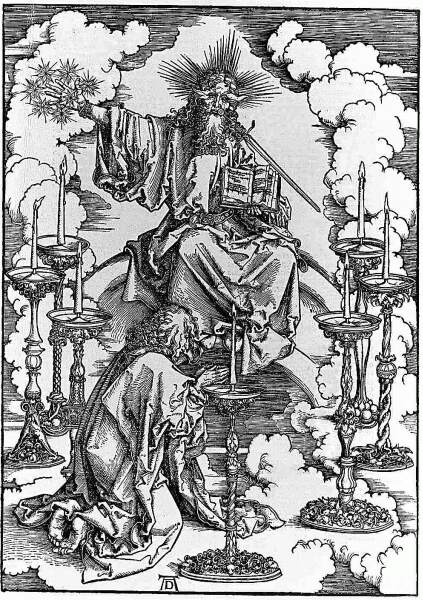
Standing among the “lampstands

The lampstands are the churches (1:20); they are vessels which shine forth God’s light.  Jesus is in the midst of the churches, not as a spectator, but as an active participant with them. The proximity of our Savior is what gives vitality to our faith.  Some Bible versions use the term “candlesticks,” but that’s a mistranslation.  Candles were not invented until the Middle Ages. [24]   

       Click here for art:  “St. John Beholds the Seven Golden Candlesticks,” Albrecht Durer, 1498.

s         Why is it important that Jesus is among the lampstands?

Clothed in a robe, with a golden girdle or sash  (compare Dan.10:5)

Kings and priests wore clothing like this, so John is describing how important Christ is.

White hair  (compare Dan.7:9)

Dignity and wisdom that come with maturity. 

Eyes like fire  (compare Dan.10:6)

The Messiah can see more than we can. He can see through all hypocrisies and deceptions; He can look into our innermost selves and see who we really are.

Feet like burnished bronze  (compare Micah 4:13)

Strength and stability.

Voice like the sound of many waters  (compare Ezek.43:2)

Penetrating, authoritative, and all-surrounding.


Seven stars in His right hand  (see Rev 1:20)

These are the “angels of the seven churches,” and Jesus supports them in His right hand.  Each of the individual messages in chapters.2-3 is addressed to that church’s “angel”.  This could refer to:

-         The church’s leadership

-         A spiritual guardian who represents each church before the throne of God

-         Each church itself represented by the one carrying the letter to that church (“angel” literally means a “messenger”)

-         When Domitian built a  temple for his imperial family, the poet Statius described him as placing the stars of his family (Flavian) in a new heaven.[25]  Jesus is described here as holding the “stars” of His family.


Out of His mouth came a sharp, two-edged sword  (Heb 4:12; 2Th 2:8)

This symbolizes His word of judgment.  This is the sword used by Roman soldiers for close hand-to-hand combat.[26]


Face like the bright sun  (compare Ex 34:29-30; Ps 84:11)

Jesus’ face shines from being in the presence of God.  He radiates the glory of God.

The Living One

Ñ         Jesus entered death (and the realm of the dead, Hades) and then returned to life.  He has the “keys” to death and it is not a barrier for Him.  Those who trust in Christ have assurance that He controls their departure from this life as well as their passage into the resurrection.  We can face death without fear, because it cannot separate us from the love of God.

s         What can we learn about Jesus from His appearance?
How would it help Christians be faithful?
What does it tell you about the future of the churches (even before we read about them)?


ÿ          Jesus gives us descriptions of Himself in order to explain what the church needs.

ÿ          He gives us images of Himself to explain His close relationship with the church.


   Lesson 3


¯        The New Song                                #258 (SFP)

¯        Jesus, Hold My Hand                       #412 (SFP)

Faithfulness without Concessions  (Revelation 2)


þ      Click here for a mapAsia Minor and the seven  churches

Ñ         As we read each letter, notice that they all have a common structure which emphasizes something about Jesus, their situation, and the consequences of their behavior.

A.      Jesus’ character

B.      Church’s situation

C.      Christ’s assessment

D.      Promise

E.       Appeal – to everyone

(        “Probably the most striking feature of the seven letters is the tone of unhesitating and unlimited authority which inspires them from beginning to end.” [27]

Rev 2:1-7

Ephesus:  Christ wants Loving Faith

A.        “These are the words of Him who holds the seven stars in His right hand and walks among the seven golden lampstands.” (compare 1:12-13,16,20)

As a leading city in the province of Asia, Ephesus could easily have been considered the “center” of those churches, but Christ points out that He holds the churches in His hand.

B.        “I know …”

Ephesus is commended for their hard work, perseverance, rejection of false teachers, and unwearied endurance.

Each church is influenced by its environment, and Ephesus was an important harbor city, but its harbor was gradually filling with silt and receding farther and farther away.  Perhaps as early as a.d.57 some ships were already beginning to avoid Ephesus.  This may have been the reason why the ship carrying Paul from Troas to Jerusalem passed Ephesus without entering its harbor. [28]

But the people of Ephesus were determined to retain its character despite the changes of nature.  This intensity of character helped the church test the teachers who came to Ephesus and reject those who were false.


C.        “I have this against you …”

But Jesus knows even more about them. He knows that they have forsaken their “first love.”  They had begun their walk on the “straight and narrow” with their eyes fixed on Christ, and they grasped that compromise was potentially destructive to their faith – so they took a firm stand against the Nicolaitans.  But somewhere along the way they began to focus more on the path than on the Guide, and their zeal for doctrinal purity became a cause which eventually usurped their love for Christ.  It is all too easy to confuse “righteousness” with “rightness.”

D.         “To those who overcome …”  (compare 22:2,14)

Next there is an encouragement from Jesus for those who will “conquer” or “overcome”.  This is a military term that emphasizes that the Christian life is a constant struggle for victory. [29]

The conquerors in Ephesus are offered the right to eat from the tree of life, a blessing which was removed when Adam and Eve chose to eat from the tree of knowledge of good and evil.  In Ephesus, “overcoming” meant that they must repent of their obsession for the “tree of knowledge” (i.e., knowing rules and facts) and return to the life of love which they knew at first (i.e., loving Christ and their neighbors).  They had to choose between “religion” and relationship.

Apparently you can participate in the church potlucks and still not be eating from the Tree of Life.

E.          “Hear what the Spirit says to the churches …”

Every letter includes the phrase “let him who has an ear hear what the Spirit says to the churches.”  This is to get the attention of all hearers, and to alert them that there is an important message here.

s         What do you think Jesus means by saying He will remove their lampstand (2:5)?

In its zeal to maintain doctrinal purity, the church had lost its original focus.  One way or another, the church must be moved from its position: either by repentance or by judgment.  Legalistic allegiance must be transformed into loving faith, or else the church will find itself stranded (like the city eventually did) without any access to the love of God.  Faithfulness is more than doctrine – it is a matter of the heart. The city of Ephesus was eventually isolated from its source of life (the sea); the same can happen to us.


s         When are we more inclined to doctrinal correctness and in the process forget our first love?

(        There is a legend about the Taj Mahal in India, which Shah Jahan built in memory of his beloved wife. He became obsessed with the details of this exquisite monument, personally driving the workers to complete it. One day he  noticed a dust-covered box that was in the way and commanded that it be discarded. He realized just in time that it was his wife’s casket. He almost threw out the reason for the monument.

Rev 2:8-11

Smyrna:  Christ wants Living Faith

A.        “These are the words of Him who is the First and the Last, who died and came to life again.”  (compare 1:17-18)

Jesus is the source of life, and He proved it by conquering death.

B.        “I know …”

Smyrna had been faithful to Rome since the very beginning of the empire; its citizens had even sent their own garments to the Roman soldiers during a difficult winter campaign.  The city regarded faithfulness as its chief glory, and Cicero expressed the Roman feeling that Smyrna was “the city of our most faithful and most ancient allies.”[30]  And so the Christians in that city had a heritage which prepared them for conflict.

The Christians endured significant opposition from Jews in the area, and this may have been a response to numerous conversions from Judaism.[31]  Christ does not condemn the Jews for being Jews, but for their hostility toward the Christians – they are an adversarial synagogue (the literal meaning of “Satan” is “adversary”).

The Lord does not promise to remove their suffering, but warns them that more is coming.  The church must continue to endure persecution, and imprisonment was often a prelude to execution (Roman imprisonment was typically a temporary condition, not an ultimate punishment).[32]  The word translated “tribulation” (or “persecution”) was also used to describe the “tramping” of sugar cane or the “pressing” of grapes.  “Ten days” was a period of testing Dan.1:12-16, but here it may refer to the extent of the suffering rather than the length of it (“ten” often carries the idea of “completeness”).  This church knew the life of faithfulness that is worth the anguish of facing death. We know from history that in the second century Polycarp, a student of John and the bishop of Smyrna, was martyred by the zealous Jews of that city.

C.        No criticism!

The persecution and poverty of the church may have helped keep it pure, because few were tempted to pride and prestige.

D.        “To those who overcome …”  (compare 20:6,14; 21:8)

The first reward they are offered is a crown of life.  “The crown of Smyrna” was a familiar phrase among the citizens of this city.  It apparently arose as a description of the hill which was used as an acropolis, with its stately buildings on top and the city spreading across its slopes.[33]  It also had a golden street which ran from one end of the city to the other.  But the reward now offered is a new crown (like the victory garland offered in the ancient Olympic games) which surpasses all buildings and towers – it is a crown of life.

The believers are promised that they will not be harmed by the “second death” (explained in chapter 20), from which we are exempt if we are willing to “die” to ourselves.  The second death is the opposite of eternal life. [34]


E.         “Hear what the Spirit says to the churches …”

The ultimate reward for this church is everlasting life.  Death is not the end for those who trust in the Lord Jesus with a living faith.


s         Do we face suffering and disappointment with a positive attitude?

s         How would the Christians in Smyrna have defined “faithfulness”?

(        There is a story about a young boy who regularly attended a church that had beautiful stained-glass windows depicting major New Testament figures. There he saw pictures of St. Matthew, Mt. Mark, St. Luke, and St. John. One day someone asked him, “What is a saint?” His reply was, “A saint is a person the light shines through.”

Ñ         “In the same way, let your light shine before men, that they may see your good deeds and praise your Father in heaven.”   (Mt 5:16)

Rev 2:12-17

Pergamum:  Christ wants Authoritative Faith

Ñ         Pergamum's library was second in size only to the one in Alexandria. Here a new writing material was developed: parchment (vellum), which derived its name from this city. [35]

A.         “These are the words of Him who has the sharp, double-edged sword.”  (compare 1:16)

This type of sword was a short sword used by the Roman army for battle in close quarters.  It was also the symbol for the highest order of official authority (i.e., proconsul of Asia).  The “right of the sword” invested such officials with the power over life and death (see Rom.13:4).  Jesus claims the authority equivalent to the highest office in the region.[36]  This was necessary because some of the Christians were tempted to justify the idolatry mandated by the emperor.  An authoritative faith in the power of Jesus Christ would help them stand the test.

B.        “I know …”

s         What did Jesus mean by calling Pergamum the place where Satan has his throne?

As the official capital of the Asian province, Pergamum was the center of persecution from the Roman authorities.  Prisoners were brought from all over the province to Pergamum for trial and sentencing.[37]  The threat in this city was not from the Jews (as in Smyrna), but from the Romans.  At least one Christian (Antipas) had already been martyred for his faith, and Jesus gives him the same title (“faithful witness”) that He gave Himself in 1:5..

C.        “I have this against you …”

The dilemma faced by the Christians was that they must either risk their lives to overcome the imperial idolatry or risk their souls by complying with the state demands.  The Nicolaitans (explicitly mentioned in 2:6) were one group who apparently decided that it was possible to remain Christians while compromising certain standards.


s         What is “Balaamism”?   Should we also be concerned about it?

-         Balaam led the Midianites to tempt the Israelites to compromise their standards (Num 31:15-16; compare 2Pe 2:15; Jude 1:11).  In the second century, Irenaeus said that the Nicolaitans argued that Christians should come to terms with the world rather than remain separate from it.

-         These people “entice” or create a “stumbling block” (2:14 - Gk. skandalon, the source of the English word “scandal”), which literally refers to the bait stick that triggered a trap. [38]


Balaam’s downfall was caused by compromise (Num.25:1-3; 31:15-16), and that is why Balaam is mentioned here.  Such compromise threatens to conquer a believer, so the play on words is certainly appropriate: [39]


Meaning of Greek name “Nicolaus

Meaning of Hebrew name “Balaam


nikan – to conquer

bela – to conquer


laos – the people

ha’am – the people


Christ says that if we compromise in order to escape death, He will exercise His own “right of the sword” to sentence us.

s         In what ways do we justify compromise in order to avoid conflict?


D.        “To those who overcome …”  (compare 19:12-13)

Christ bestows honor and dignity to those who humbly suffer for their faith.  The Nicolaitans may have mocked the stubbornness of these people, but Jesus offers them manna and a new name written on imperishable material. The Jews had a legend that manna had been hidden in a cave on Mount Sinai in anticipation of the Messiah’s return [40] – this holy food (as opposed to the idolatrous food recommended by Balaam) provides spiritual strength.

Those who overcome will also receive a white stone, which has the following possible meanings:

-         A means of voting for acquittal

-         Given to the acquitted as proof of the verdict

-         An instrument for calculating

-         Symbol of happy day

-         Ticket for bread or circus

-         Good-luck amulet

-         Legend that it fell from heaven with the manna

-         Part of high priest’s breastplate, with names of tribes on it [41]

-         Symbol of citizenship for a freed man

-         Given to the winner of a race or contest

-         Given to a warrior returning home from victory [42]


These Christians who had remained true to Jesus’ name are given a new name for themselves. A new name indicates the existence of a new person.[43]  Even in our own century some Jews have had a practice of changing a person’s name during a dangerous illness.  The emperors liked to add a new name (e.g., Augustus) to their own, to emphasize their pre-eminence.[44] But the new name that is given by Jesus is much greater than the names accumulated by the Roman emperors because it indicates our relationship with Him.  The new name is engraved on the white stone, indicating that the person belongs to something valuable (i.e., the Lord’s family).  Finally, these are secret blessings which are not shared by those who claimed to be superior.


E.         “Hear what the Spirit says to the churches …”

Jesus addresses Himself to the Christians in the official capital of the province by claiming absolute authority for Himself.  This is necessary because some of the Christians were tempted to justify the idolatry mandated by the emperor.  An authoritative faith in the power of Jesus Christ would help them stand the test.

Rev 2:18-29

Thyatira:  Christ wants Strong Faith

s         Where else in the Bible is Thyatira mentioned?  (Acts 16:14)

A.        “These are the words of the Son of God, whose eyes are like blazing fire and whose feet are like burnished bronze.”  (compare 1:14-15)

The specific term which is rendered “burnished bronze” is recorded nowhere other than this book (1:15; 2:18); therefore, it was probably a specific term known primarily to the guild of bronze workers in Thyatira. [45]

B.        “I know …”

There has been significant growth in this church, and their love, faith, service, and perseverance are exemplary.

C.        “I have this against you …”

Thyatira was established as a frontier military garrison, but had no natural fortifications to make it secure.  Its function was to strengthen a weak position and guard against encroaching danger.  The Roman empire brought peace to the region, and the location of the city was ideal for the growth of many trade guilds.  Archeologists have found inscriptions that mention guilds of woolworkers, linen makers, makers of outer garments, dyers, leatherworkers, tanners, potters, bakers, slave dealers, and bronzesmiths. Such guilds combined some of the features of our modern trade unions with certain religious activities.  Banquets often took place in a pagan temple or shrine, where the meat had been sacrificed to a local god. [46]

s         Who was Jezebel in the Old Testament?  (1Ki 16:31; 21:25; 2Ki 9:22)

-         She encouraged Israel to practice idolatry and immorality.

Guilds often engaged in worshipping pagan deities during their meetings.[47]  It is likely that the person described here as “Jezebel” (compare 1 Kings 21:25; 2 Kings 9:22) was a respected teacher [48] in the church who exercised an unhealthy influence by suggesting that Christians should participate in the idolatrous practices of the guilds.  Therefore the church in Thyatira was confronted by a danger similar to the Nicolaitans in Pergamum, but pressured by guild expectations rather than political forces.  This compromise with worldly practices is referred to by Christ as “adultery” (2:21) because it joins the Christian with the world in an unholy way.  “Her children” are probably those who completely rejected a more principled walk with Christ.  Those who have not been intimate with the “secrets” of the guild practices are only advised to hold on to their faith.


Whereas the church is Ephesus was strong in resisting false doctrine and immorality but was weak in love, the church in Thyatira was strong on love but weak in resisting false doctrine and immorality. [49]


s         What are some ways that we’ve let society or business practices establish boundaries for our faith?

(        The way they catch monkeys in Malaysia is with a gourd that has rice in it. The monkey reaches in to get the rice and its hand gets caught. It could free itself if it would turn loose of the rice, but it is too greedy. [50]

D.        “To those who overcome …”  (compare 19:15; 20:4; 22:5,16)

The victorious Christians are promised a place and position equal to the Roman emperor himself.  Only Rome exercised authority over the nations.  Therefore, the Christian is heir to a strength which is greater than all of the mighty Roman legions combined (compare Ps.2:7‑9).

Those who endure are promised the “morning star” – the promise of hope beyond the long night of suffering.  Christ is essentially pledging Himself to them, because this is His own title in 22:16.

E.         “Hear what the Spirit says to the churches …”

The church in Thyatira had to decide whether it should accept the expectations of society (i.e., the guild practices) or oppose them. Christians who wanted to do business in the various trades were exposed to ungodly practices and rejecting them meant loss of business and income.  They were in a weak posi­tion to battle the established trade unions, but they knew that Christ promises greater authority than the guilds possess.  He is the source of a strong faith.


ÿ          Faithfulness is more than doctrine. Legalism must be transformed into loving faith, or else the church will find itself stranded without any access to the love of God.

ÿ          Death is not the end for those who trust in the Lord Jesus with a living faith.

ÿ          An authoritative faith in the supreme power of Jesus Christ is needed in order to shun idolatrous behavior.

ÿ          A strong faith in the promises of Christ is what we must have in order to rise above the norms and expectations of society.


   Lesson 4


¯        Encamped Along the Hills of Light    #469 (SFP)

¯        Behold a Stranger at the Door         #919 (SFP)

Faithfulness without Conceit  (Revelation 3)


s         What did we learn about the first four churches?

Rev 3:1-6

Sardis:  Christ wants Healing Faith

Ñ         In 546 b.c. the Persian army under Cyrus besieged Sardis for several months. One night a secret path between two parts of the wall was discovered (a soldier from Sardis came down it to retrieve a helmet). That night the Persian army entered Sardis by that unguarded path and conquered it.  In 214 b.c. Sardis fell again (in almost the same way) to Antiochus the Great. [51]  This church is likely to meet spiritual defeat for the same reason that their city had suffered military defeats: they are too complacent.


A.        “These are the words of Him who holds the seven spirits of God and the seven stars.”  (compare 1:4,16,20)

Christ has complete control over the churches and over the source of spiritual power – both in heaven (spirits) and in the church (stars).

B.        “I know …”

Sardis was founded in about 1200 b.c. and was the capital of Lydia.  It grew to be a wealthy, impregnable city but was conquered twice as a result of arrogant neglect.  One of its kings, Croesus, was so wealthy that he was the model for the legend of King Midas who had the golden touch. [52]  In a.d.17 an earthquake damaged Sardis, adding to the demise of the once opulent city.  The city had grown despondent and lethargic, and the church was affected by the same influences.

C.        “I have this against you …”

The church in Sardis had a good reputation, but very little life. 

s         How can a church appear to be alive but really be dead?

-         It was chasing symptoms rather than the major problems, and only a few were prepared for future struggles.  Their spirits needed to be awakened.

©         How is our reputation better than we deserve?  Are we “resting on past laurels”?  Are we pursuing a definite purpose or are we chasing trends?  In what ways do we need revival?


s         What is the remedy that Jesus recommends for the Christians in Sardis?

-         Wake up

-         Strengthen what remains

-         Remember

-         Obey

-         Repent

If they remain complacent, they will be defeated. Jesus will “come like a thief” in judgment upon them.  Note that this is not a reference to Jesus’ general second coming, because that will take place regardless of whether Sardis is ready.  But apparently their condition was not universal, because some of the Christians had not “soiled their clothes.”  They had not grown complacent, but had remained spiritually healthy.


D.        “To those who overcome …”  (compare 19:8; 20:12-15; 22:19)

Much like today, the ancient world considered white as the color of innocence and purity. [53]  In this context, being dressed in white is a symbol of a healthy life in Christ.

The names of citizens were recorded in city registers, and they were erased upon death. [54]  Likewise, the book of life contains the names of the citizens in God’s city (Exod.32:32; Luke 10:20; Phil.4:3).  Those who are faithful are in the book.

E.         “Hear what the Spirit says to the churches …”

The church in Sardis was dying in spite of its healthy appearance.  It was chasing symptoms rather than the major problems, and only a few were prepared for future struggles.  The people needed a healing faith in order to awake their spirits.

Rev 3:7-13

Philadelphia:  Christ wants Missionary Faith

Ñ         Philadelphia was founded in the second century b.c. by Attalus II Philadelphos, one of the kings of Pergamum.  Attalus had great affection for his brother Eumenes, and so he (and the city named after him) were given the Greek name which means “one who loves his brother.”

A.         “These are the words of Him who is holy and true, who holds the key of David. What he opens no one can shut, and what he shuts no one can open.”  (compare 1:13,18)

Jesus is the one who provides opportunities.  He is in charge of Israel, both the old and the new (the “key” is a symbol of authority [55]).  He will draw people into His kingdom wherever and whenever He determines (notice how similar this statement is to the statement in Isaiah 22:22).


B.        “I know …”

The city was established for the purpose of spreading Greek language and culture into Lydia and Phrygia, so the people had experience influencing culture. [56]  An “open door” was also given to the church, meaning that it had a great opportunity to spread the gospel (compare 1 Cor.16:9; 2 Cor.2:12; Col.4:3).  There was opposition to the church, however, and it was primarily from the Jewish population.  Note that Jesus did not criticize the synagogue at Philadelphia for being Jewish, but rather for their hostility toward the Christians.

s         What does it mean to be a “true Jew” (3:9)?

s         How would the Christians in Philadelphia define “faithfulness”?

Because of the church’s patient endurance they will be protected from the trial that will be directed toward worldly people (“those who live on the earth”).

C.        No criticism!

D.        “To those who overcome …”  (compare 21:2,10-27; 22:4)

The ancient historian Strabo called Philadelphia “a city full of earthquakes,”[57] and in a.d.17 a severe earthquake destroyed Philadelphia.  The terror caused by the frequent aftershocks resulted in many people moving out of the city to live in huts.  Out of appreciation for the help received from the emperor Tiberius, Philadelphia changed its name to Neocaesarea.  During the reign of Vespasian, it assumed another imperial title and named itself Flavia, but the original name was eventually  restored. [58]

Given that the region was prone to earthquakes, it is a special blessing to be given stability and immovable strength, as “a pillar in the temple of my God.”  Added to this is the promise of security in being able to remain in the temple.

In a city which was able to express appreciation by changing its name, the church is promised a new name for itself.  These names indicate that the believer is blessed with belonging.  He belongs to God, to God's city (the church), and to the Lord Jesus. It’s worthwhile to note that the Old Testament priests were instructed to bless the people by putting God’s name upon them (Num.6:22-27) – “The Lord bless you and keep you …” [59]

E.         “Hear what the Spirit says to the churches …”

Philadelphia was a missionary city, founded to promote a unity of spirit, customs, and loyalty within the region.  Each of the seven cities in Asia was located at a “door” of opportunity for its region, but Philadelphia stood out as having missionary faith.


s         What “door” has the Lord opened for us?  Are we diligent to pursue the opportunity He has provided?

Rev 3:14-22

Laodicea:  Christ wants Humble Faith

Ñ         Laodicea was one of the richest commercial centers of Asia Minor.  It was a manufacturing center for a fine, glossy black wool, and it produced a powder which was used to heal ailments of the eyes.  This affluence had affected the church, too, because they had become completely apathetic and complacent.


A.        “These are the words of the Amen, the faithful and true witness, the ruler of God's creation.”  (compare 1:5)

Jesus is the expression of absolute truth – the “Amen” is the Lord’s confirmation that “it is so.”  The church needed some grounding in solid, unchanging principles, and Christ is the true, faithful ruler of creation who can provide such guidance. “Through Him the purposes of God are established.” [60]

B.        “I know …”

Antiochus II of Syria established Laodicea in the third century b.c., and he named it in honor of his wife Laodice.  It became one of the richest commercial centers of Asia Minor.  This affluence had affected the church, too, because they had become completely apathetic and complacent.

C.        “I have this against you …”

This church had the attitude that “I have acquired wealth and do not need a thing.”  After an earthquake in a.d.60, the imperial government offered assistance, but the city recovered without any help. [61]  The church shared this self-satisfied attitude, and could not see its true condition. Contrast these Christians with those of Smyrna: “rich, yet poor” versus “poor, yet rich.” [62]

But Jesus says He is going to vomit them up.  Their smug attitude was nauseating – like the water supplied to the city.  Laodicea's water supply came from two sources: from cold mountain springs and from hot springs.  The aqueducts were elaborate, but the distance (6 miles) changed the water temperature so that they were neither hot nor cold.  And the chemical content of the “hot” water made it nauseating.  It was enough to make you puke.

The city was a manufacturing center for a fine, glossy black wool, and it produced a medicinal powder (not an ointment) which was applied to the eyes. [63]  Christ says that their banks could not keep them from being poor, their expensive wool was not sufficient to cover their nakedness, and they were blind in spite of their medicines.  People need the Lord’s riches, the Lord’s garments, and the Lord’s medicine.

s         “Laodicea” means “rule of the people.”  What happens when the church adopts that philosophy?

s         Does God discipline His people today (3:19)?  Why?  How?


Then Jesus depicts Himself as knocking at the door (3:20), waiting to be let in as a guest to engage in fellowship with the church.  This could be an image of Christ, the lover, seeking his betrothed (see Song 5:2).  On the other hand, it might depict such complacency that no one can even be hospitable to Christ, while other churches are sacrificing their lives for Him.  What grace and mercy He shows to us even when we treat Him with such disregard!


D.        “To those who overcome …”  (compare 5:6-10; 20:4)

If they will repent, the Lord will give them the honor of sitting with Him on His throne (see 2 Tim 2:12).  There is no higher honor that could be given to a person, but there is a paradox here that makes it very difficult for anyone who is self-satisfied: it is after we give up the right to reign over our lives that Christ gives us the right to reign.  We must become dependent before we can become ascendant.  The Laodiceans thought they had already arrived.

E.          “Hear what the Spirit says to the churches …”

Laodicea possessed those qualities that made it a successful trading city, a city of bankers and commerce, which could adapt itself and accommodate any request with a spirit of compromise.  They thought they needed nothing, but Christ says they need what He alone offers.  Our independent spirits are harmful to our well-being, and we need a humble faith.


s         When is it good to be flexible, and when is it dangerous?  Do we have a view of our purpose as a church, or are we moved along by current needs?

(        “Woe to you who are complacent in Zion …”  (Amos 6:1)

s         How should a Christian deal with compromise?


What about us?

s         Look at the kinds of problems that the church faced then. Are the issues any different today?

1.        Ephesus – encumbered by change

2.        Smyrna – encumbered by religious pressure

3.        Pergamum – encumbered by political pressure

4.        Thyatira – encumbered by social pressure

5.        Sardis – encumbered by complacency

6.        Philadelphia – encumbered by insecurity

7.        Laodicea – encumbered by self-sufficiency


s         Which of the descriptions suit the body of Christians to which we belong?  What does Christ advise us to do?

q       Doctrinally correct, pursuing truth, but a little cold – like Ephesus

We have the potential for a loving faith.

q       Persecuted by religious groups, but alive in spite of suffering – like Smyrna

We exhibit a living faith.

q       Compromising certain standards in order to avoid conflict with the authorities – like Pergamum.  We are in need of an authoritative faith.

q       Oppressed by society to conform, but holding on in spite of weakness – like Thyatira.  We need the source of a strong faith.

q       Unalert, drifting, reactive to symptoms but never finding vitality – like Sardis

We need a healing faith.

q       Seizing opportunities, while patiently enduring uncertainty and slander – like Philadelphia.  We share a missionary faith.

q       Adaptable, self-sufficient, neither helping nor accepting help – like Laodicea

We must develop a humble faith.


s         It is likely that some of the names mentioned in these chapters (“Jezebel,” “Balaam,” etc.) are sarcastic nicknames.  What nicknames would our modern church deserve?  Are there some Old Testament characters who exemplify our weaknesses? [64]

-         Worship of our own souls

-         Worship of power

-         Worship of market economy


Ñ         It has been observed by psychologists that our greatest strengths sometimes turn out to be our greatest weaknesses.  Notice in the chart how closely the churches’ failures are linked to their successes.


Church

Strength

Resulting Weakness


Ephesus

Desire for moral correctness

Legalism, intellectualism


Smyrna

Willingness to sacrifice

Fear of suffering and death


Pergamum

Ability to engage authorities

Doctrinal compromise


Thyatira

An influence in society

Moral compromise


Sardis

Good reputation

Complacent, without purpose


Philadelphia

Persistence

Impatience


Laodicea

Adaptable

Ineffective, without direction


Ñ         Christ is faithful!  One of the purposes of Revelation is to show how Christ is worthy of our faith.  He fulfills the promises He makes to the churches.  Later in Revelation we’ll see the promises to the churches fulfilled.


Church

Promise

Fulfillment


Ephesus

Eat from the tree of life

Tree of life is available in the “new Jerusalem” (22:2,14)


Smyrna

Not hurt by the second death

The faithful do not experience the second death (20:6; 21:8)


Pergamum

Hidden manna; white stone with new name written on it

Invited to a wedding supper by the One who has the new name  (19:9,12-13)


Thyatira

Authority over the nations; morning star

It is Christ’s authority which prevails, and the saints reign with Him  (19:15; 20:4; 22:5,16)


Sardis

Dressed in white;
name in the book of life

Righteousness = white garments;  faithful are in the book
of life  (19:8;
20:12-15)


Philadelphia

Pillar in God’s temple;
new name

The “new Jerusalem” has a firm foundation, and God is its temple; God’s name is written on us  (21:2,10-27; 22:4)


Laodicea

Sit with Christ on His throne

Saints reign on earth and in heaven  (5:6-10; 20:4)


ÿ          A healing faith will awake our spirits and prepare us for the future.

ÿ          A missionary faith will open “doors” of opportunity to share our assurances.

ÿ           A humble faith is the antidote for our arrogant, independent spirits.

ÿ          We must pay attention to how our greatest strengths turn into our greatest weaknesses.


   Lesson 5


¯        Holy, Holy, Holy!                            #47 (SFP)

¯        Worthy Art Thou                           #230 (SFP)

Sovereignty  (Revelation 4-5)

Rev 4:1-11

The Throne Room

s         Where are we now?

-         John's visions now take on a different character.  The descriptions that Jesus gave in chapters 2-3 were observable and comprehensible, but the rest of the book seems very other-worldly.  That’s because it is!  Jesus is giving us a look behind the curtain, a glimpse at what we can’t see ourselves.  Just as Elijah needed to be shown that God has legions of warriors ready to advance, so the church also needs to know how the Lord is exercising His authority.

Ñ         Before we investigate this particular vision of heaven, we should first notice the various ways that the throne of God is depicted in this book:


1.        Temple (or tabernacle) with altar and sacrifice (Chap.4, 8)

2.        Synagogue where scroll is read (Chap.5)

3.        Headquarters for God's forces in the conflict with Satan (Chap.7)

4.        Court where the prosecuting attorney loses his case (12:10) [65]

5.        Wedding banquet (Chap.19)

6.        Census or Probation Review (books are consulted – Chap.20)

7.        Holy City (Chap.21-22)

Ñ         In chapter 4 the heavenly sanctuary has the overall appearance of the tabernacle or temple of the Old Testament:


   Revelation 4

    Tabernacle (Temple)


Living creatures

6 wings,

many eyes

 
Lion

Calf

Man

Eagle

Û        Cherubim on the ark of the covenant


7 lamps of fire before the throne

Û        7 lamps before the holy of holies


24 elders on 24 thrones

White garments

Golden crowns

Û        24 orders of priesthood, divided among the descendants of Aaron


Sea of glass

Û        Laver (bath) which stood before the holy of holies


Ñ         The throne of God (4:3) is described in a mixture of color and light (gem stones) surrounded by a rainbow.  From His presence come flashes of lightning, sounds, and peals of thunder, which exhibit His majesty and strength (1 Sam.2:10).  And everyone in this tabernacle-scene falls down before the throne and worships God as the great and holy Creator.


Ñ         The 24 elders (4:4) are dressed in a manner that suggests that they are kingly priests.  These could represent the priesthood as divided among Aaron's descendants (1 Chron.24:7-18), or they could symbolize two covenants: 12 Old Testament patriarchs (or tribes) plus 12 New Testament apostles.  Since the writer of this book was one of the apostles (and not inclined to elevate his own position), it is more likely that the complete priesthood is in view.

When the 24 elders worship God, they refer to Him as “our Lord and God.”  This is the very name that the emperor Domitian demanded to be called.  Casting their crowns before the Lord is a sign of complete submission.

Ñ         These seven lamps (4:5) are not the same as the “lampstands” (i.e., the churches) in chapters 1-3.  These exhibit the fire of God and represent His Spirit.  So now you know the significance of the seven lamps in the Old Testament tabernacle.

Ñ         The four living creatures (4:6-9) are probably cherubim or seraphim.  They symbolize what is the noblest (lion), strongest (young bull), wisest (human), and swiftest (eagle) in creation.  In later centuries of the early church, it was customary to associate these images with the four gospel writers: Matthew (lion), Mark (man), Luke (ox calf), and John (eagle).[66]  The four living creatures are mentioned fourteen times in this book, and they are essentially the choirmasters leading the public worship and adoration of God. [67]

Ñ         The “sea of glass” recalls the image in Exod.24:10 of God standing on what looked like a pavement of sapphire.  It depicts great distance and tranquility, like looking out at the ocean on a still, clear day.  This emphasis on the distinction between God and everyone else is continued in the hymn that is sung in 4:8 - God is most holy.  The second hymn (4:11) honors God as Creator.

(        The praise in these chapters (especially 4:11) sounds pretty routine for us, but it was a minority view in the first century, and it got Christians in serious trouble. [68]


Ñ         Why all the formality? There are two primary themes that the Lord wants to clarify in this book: authority and worship.  The struggling Christians needed to know who was really in charge, and where they should direct their allegiance and devotion.  This was evident in the church situations described in chapters 2-3.  They were in danger of compromising their loyalty to Christ.  Chapter 4 addresses both themes at once in a way that is intended to make an impression.

Rev 5:1-14

Who is worthy?

s         What is the crisis presented in this passage?

-         The major crisis of the entire book begins with a scroll which God holds in His hand.  It is so full of content that it is written on both sides.  However, it is sealed with 7 seals, and no one could open it.

Ñ         A scroll was usually made of sheets of papyrus pasted together and then rolled from one end.  They were usually written one side. The seals were made by melting wax on the edge of the rolled-up scroll. Typically the mark of the sender was pressed into the wax. [69]


s         What could the “opening” of the seals indicate?
Why does John weep?

-         Apparently the “opening” of the scroll involves more than simply revealing its contents:  perhaps whoever opens it is responsible for controlling and developing what is to follow.  The destinies of the people involved lie in the hands of whoever dares to step forward.  John weeps because no one can open it. [70]

Ñ         One of the “elders” introduces the Lion of Judah (Gen.49:9-10), the Root of David (Isa.11:10), but when John looks he sees a Lamb - one that had been slain as a sacrifice.  He looked to see the power that would destroy the enemy, and he sees sacrificial love and gentleness.  But this lamb, who is Christ, also has authority (7 horns – see Deut.33:17; 1 Kings 22:11) and is all-knowing (7 eyes/spirits).

s         How can Christ be both a “Lion” and a “Lamb”?

-         The noblest son of a tribe was called the lion of the tribe.  Gen 49:9 and Isa 11:1-10 were interpreted as referring to the Messiah. [71]

s         What makes the Lamb worthy?

-         Only the Lamb, Jesus, is worthy to open this scroll - not because of power or majesty, but because of His love for mankind.  Because Jesus spans the gap between our humanity (chapters 2-3) and God's holiness (chapter 4), He is worthy to pull back the veil (or in this case, open the scroll) between our limited knowledge and God's purposes.  This is the essence of the “new song” in 5:9.  Jesus is worthy because He sacrificed Himself.


Ñ         Notice that Christ does not alter the divine plan, but His obedience allows it to unfold.  The Lamb of God fulfilled God’s mission for His people.  Jesus Christ is central to this scene:

-         He is by His Father's throne

-         He is among the lampstands (amidst the church)

-         He is worthy to reveal God's purposes


©         Are there areas that we need the Lord to “unseal” for us today?
In what ways do we need both the Lion and the Lamb to do this?

Ñ         The Lord God was revealed in chapter 4 as sovereign over all creation.  In chapter 5 we are shown that Jesus the Lamb has received authority over all powers by His sacrificial death.  Furthermore, the saints are allowed to reign as royal priests, because they have been purchased by the blood of Jesus (5:10).  We can see that the saints have an active role in God’s plan, because their prayers are offered before the Lord as incense (5:8).  Whereas the Roman Emperor demanded authority, the Lord God has made the Lamb and the saints worthy of authority.

Ñ         Notice the musical arrangement of this scene [72] – it is meant to encourage a sense of victory and hope among the struggling believers.

4:8              Quartet                                       Four Living Creatures

4:11            Choir                                          24 Elders

5:2              Solo                                            Strong Angel

5:5              Solo Response                       One of the Elders

5:9-10        Unison of Quartet & Choir     New Song (4 + 24)

5:12            Majestic Chorus                      Angels

5:13            All - Grand Finale                     All Creation

5:14            Quartet Response                  Four Living Creatures


ÿ          The Lord God is sovereign over all creation.

ÿ          Jesus the Lamb has received authority over all powers by His sacrificial death.

ÿ          The saints are allowed to reign as royal priests, because they have been purchased by the blood of Jesus.

ÿ          Two primary themes arise in this section: authority and worshipThe struggling Christians needed to know who was really in charge, and where they should direct their allegiance and devotion (chapters 2-3).  Here we are reminded that Jesus reigns today and forever, among us and within us.


   Lesson 6


¯        On Zion’s Glorious Summit              #227 (SFP)

¯        Faith of Our Fathers                      #754 (SFP)

Love in the Midst of Suffering  (Revelation 6-8)

Rev 6:1-8

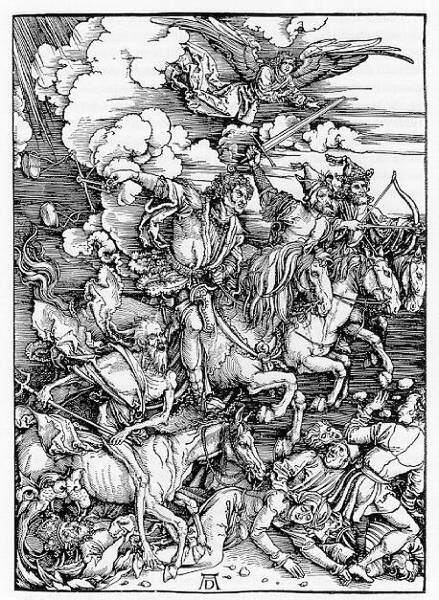
The Four Horsemen  (Seals 1-4)

s         What is the first horseman carrying?  What is he doing?

Ñ         1st Seal:  White Horse – Conquest, Power Struggles

-         The rider carries a bow, which was seldom used in Roman armies.  However, it was the weapon of choice among the Parthians, who were a fierce neighbor on the eastern border of the Roman Empire.  Furthermore, white horses were sacred among the Parthians (as well as the Persians before them).  The image of a crown completes the picture of a victorious conquest.[73]  It is not clear whether people are being threatened by an earthly army (such as the Parthians) or whether this is a heavenly attack, but in either case it will be directed by the Lord – He is the one who opens the seals.

s         What is the second horseman doing?

Ñ         2nd Seal:  Red Horse – Killing, Bloodshed

-         The rider carries a sword, and he takes peace away from the earth by making people kill each other. Rather than viewing this horseman as a new threat in addition to the first horseman, our understanding should be that each horseman adds more detail to a single image.  We are now led to see the bloodshed that follows this attack.

s         What is the third horseman doing?

Ñ         3rd Seal:  Black Horse – Shortages, Scarcity

-         The rider carries a pair of scales for weighing the rations of food, which are priced at the limit of affordability.  Less basic items like oil and wine are not as scarce.  The warfare is followed by inflation and specific shortages of basic food supplies.

-         At the insistence of Rome, farmland in Asia Minor had been converted to produce oil and wine for export. This created a shortage of grain in Asia Minor. [74]

s         What is the fourth horseman doing?

Ñ         4th Seal:  Pale (yellowish-green) Horse – Death

-         The Greek word for this color is chloros, which is a sickly greenish-yellow, intended to look like decaying flesh.

-         The rider is named “Death”, and is followed closely by “Hades” (the realm of the dead).  They have power to spread the four judgments mentioned in Ezek.4:21 (sword, famine, pestilence, and wild animals).  These are the aftermath of war, as the land is devastated by robbers, disease, and wild animals.


       Click here for art“The Four Horsemen of the Apocalypse,” Albrecht Durer, 1498.

s         Who (or what) are these horsemen?

-         This is a popular passage for doomsday prophets. We must keep in mind that this is poetry, not documentary.

-         It was explained to Zechariah (Zech.6:5) that they are four spirits of heaven, going forth through the earth after standing before the Lord (the colors weren't as significant in Zechariah's vision). 

-         Their character instructs us about the nature of what to expect in the situation on earth.  The world must suffer the tragedies of conquest, bloodshed, scarcity, and then death.  The world is struggling and suffering – we’re not told how it is happening, but we are told that the Lord has control over it (He opens the seals).


(        One of the features that distinguishes the book of Revelation from other books of the New Testament is the author's attempt to show how power fits into the divine scheme of things.  John begins with the belief that all power comes from God.  But because God gave humankind free will, there is always the possibility that we might misuse the portion of power entrusted to us. ... The way that God's power is manifested in the world is that the misuse of power brings on suffering and disaster. ... God does not approve of famine and death and hell, but they are what must follow if people persist in opposing God's rule. [75]

Rev 6:9-17

The Cry and the Reply  (Seals 5-6)

s         If you had a loved one who had died for his/her faith, how would 6:9-11 affect you?

Ñ         The martyrs who cried out (6:10) must have been affected by the 4 horsemen somehow.  That means that the 4 horsemen (Seals 1-4) must refer to some conflict that had already been happening.

Ñ         5th Seal:  Suffering Servants

-         When this seal is opened, we see the souls of the martyrs – those who had been faithful unto death.  They cried out, “How long, Lord, will you refrain from judgment?”  They are given robes and told to wait, because more Christians would suffer and die!

s         What symbols are usually associated with judgment?

-         The use of cosmic convulsions to describe social and political upheaval is common in Biblical prophecy (Jer.4:23-26). [76]   The people seek refuge as they did when attacked by the Assyrians (Hosea 10:8), the Babylonians (Isa.2:19), and the Romans (Lk.23:30)

Ñ         6th Seal:  The Answer to the Saints

-         The world of the ungodly is graphically taken apart by God.  As the Lamb unseals the scroll, the immediate impression we get is of a suffering world.  Even death is preferable to the Lord’s judgment.  God's wrath is so great that the people ask, “who is able to stand?” (compare Nahum 1:6).


Ñ         If God is in control, surely His church is protected from these woes – right?  The answer of Seal 5 is “no”; the church is not exempt.  God's people are often tested to the limit. [77]  But how long?  The saints’ question is answered in Seal 6: with the judgment of the wicked and the end of their world.

(        “God has heard the protest of His people and will honor his promise to be with them and to save them, if not from their troubles, then in their troubles.” [78]

Rev 7:1-17

Sealed for the Tribulation  (Interlude)

Ñ         In ancient times, most people couldn’t write, so they used a seal as a mark of responsibility or obligation – like a signature. [79]

Ñ         Interlude before the 7th Seal

-         An angel comes forward and calls to the others to wait.  God’s people must be “sealed” before the cataclysm can take place.  This “seal” is a sign of possession, assurance and protection, and it is conspicuous for all to see.  They are preserved from destruction, but not spared from persecution.  Though the righteous are exempt from a given judgment, this doesn’t mean they don’t suffer during it.

Ñ         “144,000”

-         Those who are sealed before the tribulation are given a number: 144,000. The number describes who they are (complete and holy), not how many they are.

-         They are from the tribes of Israel, but the names of the tribes are different: Dan is missing (Jdg.18), Levi is included, and Joseph is included instead of his son Ephraim (Gen.48:14; 48:19‑20).  Most commentators think this has something to do with the faithfulness of the tribes.  We are apparently supposed to understand that Israel was not the same as before.

-         They probably represent believing Jews (not all who claimed to be Jews, as pointed out in Rev 3:9), and God has been protecting them through the trials that come upon the earth.

-         It is a mistake to consider references to “Israel” as now including both Gentiles and Jews (i.e., as a “New Israel,” a phrase which never appears in the Bible). Although the Gentiles are united with the Jews in one body (Eph.2:11-22; 3:6; Rom 10:12), we should remember that salvation is from the Jews (Jn.4:22). They have had the history of covenants, promises, and glory which the Gentiles are only “adopted” into.  Therefore it should not surprise us when we encounter Scriptures (such as Isa.49:6; Luke 2:32; Acts 13:46-47; Rom.15:27; Rev.7:4-9) which display God’s light shining first upon the redeemed of Israel, and then also upon the Gentiles. Believing Gentiles are “grafted” into the “root” of Israel, but that does not make them Israelites. The true Israel is composed of all believing Jews before and after Christ’s atoning sacrifice. God’s promise to never forsake Israel (Ps 89:28-37; Lev.26:44; Jer.33:20) does not provide unbelieving Jews a “second chance” for salvation at a future time. It is the “church” that has always been God’s plan (Eph.3:10-11) for creating in Christ one body built on the foundation of both the apostles and the prophets.


Ñ         “A great multitude”

-         They are described as the ones who are coming (note that it is not future tense) out of the “great tribulation” (i.e., the events of the first 6 seals).

-         The white robes and palm branches emphasize that these are the victors!

-         They are from every nation – consisting of all believers who overcome the world by remaining completely faithful to the Lord (they “serve Him day and night”).


s         What is the “great tribulation” (7:14)?

-         It is a tribulation which has been ongoing (believers have come out of it, some martyred).  There is not a clear explanation of who the attackers and sufferers are in Seals 1‑6, but it appears that Christians suffer because of it.  Perhaps it summarizes the trials experienced in the Asian provinces since Nero (a.d.64), including the destruction of Jerusalem (a.d.70), even to the time of the writing of this book.

-         Popular interpretations of the “Great Tribulation”:

1.        Fall of Jerusalem (a.d.70)

2.        Future struggles (a very popular view today)

3.        Summation of all Christian struggles

4.        Roman persecution (lasted 249 years) [80]


Ñ         John is introduced to two groups: he sees protection and assurance given to believing Jews prior to persecution (he is told that they are “144,000”), and then he sees an innumerable multitude (from all nations) victoriously coming out of the persecution.  Perhaps with the relatively recent defeat of the Jewish revolt (a.d.70), some Christians were wondering whether the Lord had rejected Israel completely, but the Jewish Christians were protected along with other Christians through the terrible tribulations of this period. There is no indication in this passage that either group is to be placed sometime in the future.

Rev 8:1-5

The Secret Weapon  (Seal 7)

Ñ         7th Seal:  the Power of Prayer

-         Instead of the singing and shouting of praises, there is now a solemn and awe-inspiring silence – like a “drum roll” before an event.  We expect a major cataclysm, but there is none.  An angel mixes incense with the prayers of the saints upon the golden altar.  The smoke of the incense, along with the prayers, goes up before God.  Then the angel throws fire (from the same altar) onto the earth.  The seventh seal reveals the invincible power of the Christian's secret weapon: the divine response to the prayer of faith. [81]  This introduces us to the “trumpets” which will announce God's wrath upon the ungodly – ushered in by the cries of the saints.

-         In West Texas there are vast reaches of semi-desert plain where ranchers have modest homes and they tend large flocks of sheep. On the surface it appears to be a poor land. But there’s something underneath that makes it potentially wealthy – oil.  But to obtain the prize you have to get access to it. Similarly, God offers us great riches, and prayer is our “drilling rig.” [82]


s         What do the “Seals” mean?

-         Seals 1-4, which showed us the world suffering, were followed by Seal 5, which reminded us that the church must suffer too, and there will be no escape from suffering until the world is judged with Seal 6.  But the Christian has an inner security that is not affected by external trials. [83]

-         The first six seals present a shocking spectacle to the Christians: they must suffer while the world is judged!  But Seal 7 shows us that God protects the faithful.  He exhibits His love by giving assurance to those who belong to Him and by answering their prayers.

(        “It is impossible that any ill should happen to the man who is beloved of the Lord.  Ill to him is no ill, but only good in a mysterious form.  Losses enrich him, sickness is his medicine, reproach is his honor, death is his gain.” [84]

©         What have been some of the greatest “tribulations” in your life in Christ?  How does the assurance of God’s love help you endure?  In what ways has God answered your prayers?


ÿ          Seals 1-4 show us the world suffering.

ÿ          Seal 5 reminds us that the church is not exempt from suffering.

ÿ          There will be no escape from suffering until the world is judged with Seal 6.

ÿ          The interlude before Seal 7 shows us that God protects the faithful.  He exhibits His love by giving assurance to those who belong to Him (both the “144,000” and “the great multitude”).

ÿ          Seal 7 reveals our secret weapon: God answers our prayers.


   Lesson 7


¯        A Mighty Fortress                          #10 (SFP)

¯        Hail! Ten Thousand Harps                #277 (SFP)

Judgment rather than Redemption  (Revelation 8-9)


God Pours Out His Wrath (Trumpets 1-4)

Ñ         Revelation is intended to make its impact upon our senses and imagina­tion.  First John saw the seals.  Now he hears the trumpets.  Here we are shown God answering prayer. [85]

s         Can you remember some ways that trumpets were used in the Old Testament?

1.        To call assembly (Num.10:1-8)

2.        Warning/Alarm (Num.10; Jer:5; Ezek.33:3)

3.        Triumph – over Jericho (Josh.6:4)

4.        Coronation – of Solomon (1Ki.1:34)

Rev 8:6-13

s         Who are the “seven angels”?

-        The seven trumpets are about to be sounded by seven angels who stand before the throne of God.  According to Jewish tradition, there was a special group of seven angels who were above the rest.  In the apocryphal book of Enoch their names are given: Raphael, Uriel, Raguel, Michael, Sariel, Gabriel, and Remiel. [86]

s         What was affected by the first trumpet?

Ñ         1st Trumpet:  Wrath upon the Earth

-         Hail, fire, and blood are typical images of judgment (see Isa.28:2; 30:30).  One-third of the earth is destroyed.

Ñ         2nd Trumpet:  Wrath upon the Sea

-         A mountain is thrown into the sea, recalling the fall of Babylon (Jer.51:24-26,42).  Mt. Vesuvius erupted in a.d.79 and buried Pompeii, Italy.  Having heard reports of this disaster, the readers of this book would have had little trouble imagining a mountain thrown into the sea. [87]  Now the oceans are affected by the judgment.

Ñ         3rd Trumpet:  Wrath upon the Rivers

-         A great burning star falls onto a third of the rivers and springs (compare Isa.14:12-15, which was proclaimed to the king of Babylon; also see Lk.10:18, in which Jesus refers to Satan).  The name of the star is Wormwood, which is a bitter wood that is usually connected with the consequences of idolatry (Jer.9:13-16). [88]


Ñ         4th Trumpet:  Wrath upon the Sky

-         One third of the lights in the heavens are darkened.  Throughout the Old Testament, light from the sun, moon, and stars signifies salvation, well-being, happiness, truth, wisdom, and joy.  The fading light in the removal of these heavenly bodies symbolizes judgment from God. [89]


s         Why is only one-third of everything affected?

-         The majority of mankind is allowed to survive, being shown God’s wrath against sin, and given the opportunity to repent.  Paradoxically, the trumpets show the wicked world being offered mercy in the midst of judgment.  In other words, we should be asking, “why were two-thirds spared?”  The effects of these trumpets are similar to the plagues in Egypt, and their importance was that people could not understand how they happened and had to admit that God was at work. [90]  The catastrophe is severe but not final.

Rev 9:1-12

Persistently Faithless  (Trumpets 5-6)

s         What was the purpose of locust plagues in the Old Testament?

s         How are these locusts described?

Ñ         5th Trumpet (1st Woe):  The armies of the earth

-         The key to the bottomless pit is given to a fallen star, and when the hole is opened an immense plague of locusts and darkness explodes from within the earth.  The locusts are armed like scorpions, shaped like horses, crowned like kings, with the faces of men, the hair of women, the teeth of lions, armor-plated, winged, and moving with deafening noise.  They attack people instead of vegetation, and they are able to discern between Christians and non-Christians.  They are not allowed to kill, but they torment people to the extent that they wish for death.  Their king is named Abaddon in Hebrew (which means “destruction”) and Apollyon in Greek (which means “destroyer”). [91]  Obviously, their mission is to destroy.

-         Notice that these creatures come from within the world to torment those who are of the world.  Here is a picture of unbelievers being tormented by evil and spiritual decay – the very  things which they have followed instead of Christ.

-         The attack lasts for 5 months, which is the usual life-cycle for some species of locusts. [92]

-         In 1915, there was a locust plague in Palestine.  A National Geographic article that same year described it as follows:  “It was one of the last days of February, 1915, that Mr. Lewis Larson … returned … with word that swarms of locusts had flown overhead in such thick clouds as to obscure the sun for the time being. However, before they were seen, a loud noise, produced by the flapping of myriads of locust wings, was heard, described as resembling the distant rumble of waves, or ‘… as the sound of chariots of many horses running into battle.’” [93]

Rev 9:13-21

s         How is this army in v.17-19 described?

Ñ         6th Trumpet (2nd Woe):  The armies of God

-         A voice is heard from the four horns of the golden altar which is in God’s presence.  This clearly indicates that the image is to be understood as having God as its source.  The first woe was from the earth; this one is from God.  The army we now see consists of 200 million armed warriors on fire-breathing, lion-headed, snake-tailed horses rampaging out of Mesopotamia to kill one-third of mankind.

-         The region of the Euphrates had a connotation of being the origin of several threats of destruction in the Old Testament, as well as for the Roman Empire.[94]  The Parthians were the current menace from this region. They had defeated the Roman  armies at Carrhae in 53 b.c. and at Vologeses in a.d.62, and Rome felt its greatest sense of insecurity in that region. [95]


Ñ         The trumpets are warnings, intended to bring the world to repentence.  The fraction which are not destroyed symbolizes the mercy of God, because He is a redeeming God, not a punishing God, and wrath is His last resort..  People are threatened by the evil in the world and the judg­ment of God, but they refuse – they prefer to disregard both God and mankind.  Both armies assail the worldly people with no success, and John identifies the sin to which they stubbornly cling: idolatry (9:20-21).  They have chosen the world as the object of their worship and the source of their authority.  They have chosen judgment over redemption.


ÿ          God is at work trying to bring everyone to Him.

ÿ          The trumpets are warnings, intended to bring the world to repentance.

ÿ          But people have chosen judgment over redemption.


   Lesson 8


¯        Crown Him with Many Crowns           #193 (SFP)

¯        Hallelujah Chorus                           #29 (SFP)

Redemption rather than Judgment  (Revelation 10-11)

Rev 10:1-8

Persistently Faithful  (Interlude)

Ñ         In the beginning of chapter 10, John sees an angel who must have really impressed him.  Three times he mentions that the angel was standing on the sea and on the land! (10:2,5,8)  The stance may indicate the broad scope of the message. [96]

Ñ         “Seven Thunders”

-         As we observed with the seals, now we have another dramatic interlude before the trumpets are concluded.  An angel comes forth from the presence of God (rainbow on his head, face like the sun, feet like pillars of fire - see chapter 4).  He cries out and then seven thunders speak.

-         John has grasped the cyclical nature of the visions and gets ready to write down what he sees; however, this time he is told to not write the message down.

Ñ         “No more delay”

-         Then the angel swears by God that the “delay” will last no longer.  What delay? – the period while the ungodly were given time to repent.  Apparently there is no point in offering further opportunities. [97]

-         The angel also says that with the sounding of the seventh trumpet, the “mystery of God” will be complete.  What does that mean?  Apparently John needed an explanation too, because he was told to take a little book from the angel and eat it.

Rev 10:9-11

s         What might be the significance of John “eating” the book?  What makes a message “sweet” or “bitter”?

-         We use a similar image when we talk about “devouring” a good book.

-         In the cited reference (Ezek 2:9-3:7) the prophet is sent to speak to God's nation in exile, but they stubbornly refused to listen.  Therefore the inference in Revelation is that everyone (perhaps including Christians) is slow to listen to God’s message, and that may have been part of the reason for the “delay.”.

Ñ         “Eating the book”

-         It tasted sweet at first, but made his stomach bitter (compare Ezek 2:9-3:7).  The message offers relief to some and bitterness to others, for it speaks of great wrath for those who will not repent (especially those within the household of God).  God’s message is completed with wrath and judgment for those who refuse to repent, and there will be no more delay.

Rev 11:1-2

s         What is the purpose of measuring?

-         to build & repair

-         to separate the holy from the profane

Ñ         Measuring the temple – examining  the church's worship

-         Basically, we’re supposed to consider how the church has measured up.  The seals showed us that the church would suffer, but what about its work, its effect, its witness?  John is told to measure the sanctuary of the temple, its altar, and its worshippers – but not the court outside, which was “cast out” and would trample the “Holy City”.

-         This passage should not be used to suggest that the book was written before the temple was destroyed in a.d.70, because after Jesus formed the church, it became the temple of God (1 Cor.3:16; 2 Cor.6:16; Eph.2:21).  And it would be rejected and “trodden under foot” for a period of time.  The three and a half years of Gentile domination recalls the defilement of the temple by “the abomination that desolates” (Dan.9:27; 12:7), fulfilled in a.d.167-164, but firmly established as a symbol of oppression by the world.

Rev 11:3-14

Ñ         The Two Witnesses – examining the church's authority

s         Do these 2 witnesses remind you of anyone from the Old Testament?

-         The 2 olive trees suggest Joshua & Zerubbabel (Zech.4:1-14)

-         The miracles suggest Elijah (2 Ki.1:10) and Moses (Exod.7:17,19)

God grants authority to His “two witnesses” to prophesy and to perform some amazing deeds.  No one can harm them before their mission has been accomplished.  But then a beast from the pit overcomes them and kills them.  Their bodies lie in the street of the “great city” which is given three names to emphasize its character:


Sodom

–  Believers oppressed by immorality


Egypt

–  Believers oppressed by slavery  and bondage


Jerusalem

–  Believers oppressed by rejection of truth


The nations rejoice in triumph, but the Lord raises the two witnesses up after three and a half days, and they are called to heaven in the sight of their persecutors.

Ñ         Chapter 11 has revealed two very different perspectives of the church: [98]

1.        The sanctuary is measured and preserved, and the two witnesses are invincible – the “sweetness” of God’s plan (i.e., the book John ate).

2.        The “Holy City” is trampled, and the beast is victorious over the two witnesses – the “bitterness” of God’s plan.

s         What are some appropriate ways to “measure” the church’s faithfulness?


(        When Wellington faced Napoleon at the Battle of Waterloo, everyone in England was anxious for the outcome. After the battle was over, a sailing ship semaphored a message to a signalman on top of Winchester Cathedral.  He would in turn send the signal to another station, and so the news was relayed by hand semaphore across England. The signalman on the ship sent the first word: “Wellington.” The next word was “defeated,” and then a fog rolled in that obscured the ship from view. “Wellington defeated” went across England, and there was great despair throughout the country. After a couple hours, the fog lifted and the message was completed: “Wellington defeated the enemy.” Then all England rejoiced. We must be cautious that we do not judge the church’s condition (whether positive or negative) too hastily, because we do not see as clearly as the Lord does. [99]

Rev 11:15-19

The Lord Reigns  (Trumpet 7)

Ñ         7th Trumpet (3rd Woe):  The Mystery Complete

Ñ         “The kingdom of the world has become the kingdom of our Lord and of His Christ; and He will reign forever and ever.” (11:15)

-         If the trumpet is a one-time “event,” then we might want to search for when it would happen. But it is actually a principle about the kingdom of God.

-         Amid shouts of praise, God takes back the world which the ungodly thought belonged to them.  We might have expected a battle scene, but God had already won, and the wicked have been cast out from His presence.  The third woe (Trumpet 7) signals the completion of God's mystery which was looked for and sought by the prophets (see 10:7).

s         What is the kingdom of God?

-         The word “kingdom” in the New Testament primarily refers to rule, reign, kingly power, and dominion.  It is seldom used in the New Testament to mean a specific territory.


s         Didn’t the kingdom already belong to the Lord?

-         God has reigned as supreme King of creation since the beginning (Isa.37:16; Jer.10:10-12).  He rules over everything (including all peoples) in creation (Ps.148).  Therefore His kingdom has always existed and all creation is under His dominion. At Sinai a new expression of God's sovereignty emerged: Israel became a specific manifestation of God's rule which was different from other parts of God's kingdom.  Pharaoh was His subject as surely as Moses, but God had a special relationship with Israel and Moses.  It was a covenant relationship that depended upon the faithfulness of the people as well as God.  When David was made king, he recognized that he merely represented God’s throne (1Ch 29:10-13), and David’s throne was the one upon which the Messiah would also sit (Isa 9). Jesus’ disciples expected Him to restore God’s kingdom (Acts 1:6), and by that they meant the dominion of God that had been given to David's descendents. Jesus’ promised reign is upon the throne of David, ruling over those who are subject to God’s covenant. In short, God reigns over everything, but David’s throne (and the dominion of the Messiah) was associated specifically with God’s covenant people.


-         Since God controls the universe, He has the ability to reconcile the world with Christ. And that is exactly what He did when Jesus was crucified for the sins of the world (Eph 2:14-18; Col 1:19-20).

-         Perhaps Rev 11:17 describes the Lord expressing His royal authority, put into action as a direct response to the faithfulness of Christ and His witnesses. [100]

Ñ         Here is a major climax of the book (or at least a major turning point), because here we have the consummation of authority (one of the two major themes of the book).  The Lord reigns!  And the church has persevered!  It is the fulfillment of Dan.2:44, the establishment of a kingdom that will never be destroyed.  The church has been given redemption instead of judgment.


s         What do the “Trumpets” mean?

-         Although the trumpets follow the seals in the narrative, we should not necessarily assume that they depict events which are chronologically later.  It is typical in Jewish writings to emphasize a theme with multiple stories or descriptions, so we should probably interpret the trumpets as somehow complementary to the seals and not a separate sequence of events.  In other words, the trumpets and the seals offer two perspectives on the same themes (authority and worship).  This approach would also offer an explanation for the similarities between the two sets of visions.

Ñ         Chapters 4-11 are summarized in 11:15-19.

11:15       The consummation of authority

11:16       The centrality of worship

11:18       God is long-suffering but just

11:19       Assurance of access to God’s presence and covenant

Ñ         The seals reveal to us that the love of God is assured in the midst of suffering. When times are tough, our best action is to worship God.

Ñ         The trumpets warn us (or announce to us) that the God of mercy allows opportunity for all to repent and be redeemed for His kingdom.  Although it may appear that ungodliness prevails, the Lord makes His authority known – He and His people reign forever.

©         If John were to “measure” our congregation, what would he discover?  Based on the fruits of the Spirit (Gal.5:22), describe our strengths and weaknesses.

s         Has God granted authority for us to do any amazing things?


s         How does it affect your faith to know that the “Holy City” may sometimes be “trampled”?  How does it affect your faith to know that the Lord makes the church’s witness invincible?

s         In what way has the kingdom of [your nation or state] become the kingdom of the Lord?

s         Are suffering and judgment equivalent?


ÿ          After being delayed by the refusal of people to listen, God’s mystery is revealed:

Ø       The “sweetness” of God’s plan is that the “sanctuary” (i.e., the church’s worship) is measured and preserved, and the authority of the two witnesses is invincible.

Ø       The “bitterness” of God’s plan is that The “Holy City” is trampled, and the beast is victorious over the two witnesses.

ÿ          Trumpet 7 presents a major climax of the book, as the kingdom of the world becomes the kingdom of our Lord. Christ reigns!

ÿ          The church has been given redemption instead of judgment.


   Lesson 9


¯        There Is a Habitation                     #860 (SFP)

¯        Let the Lord Be Praised, O Zion!      #207 (SFP)

¯        Arise and Sing                               #706 (SFP)

The Church and the World (1)  (Revelation 12-14)

Rev 12:1-17

The Drama

Ñ         We are now introduced to a brief drama which gives the context for the remainder of the book.  It sets the stage for a message of choices and consequences.

s         Who are the characters in this drama?

Ñ         A woman, about to give birth – God's faithful people
(Micah 4:10; 5:2-3; Isa.66:7-8).  Her garments are celestial:

-         Clothed with the sun

-         Moon under her feet

-         Crown of 12 stars

Ñ         A red dragon – Satan  (12:9)
His appearance indicates authority, power, and evil:

-         Seven heads, wearing royal crowns

-         Ten horns (indicating power and authority)

-         A tail that sweeps stars from the heavens (compare Dan.8:10, which refers to another oppressive king in Greece)

-         Waiting to devour the woman's child

Ñ         A male child, born to the woman – Jesus (12:10; also Ps.2)

-         He also has authority, and it is from God

-         The child joins the presence of God, while the woman flees into the wilderness for safety and protection

-         Jesus’ entire life on earth is described in one verse

Ñ         Michael, Israel’s champion – God's representative to deal with Satan
(12:1; also Dan.10:21)

-         He and his angels defeat the dragon and his angels

-         Notice that neither God, nor Christ, nor the believers enter the battle

Ñ         Other offspring – Christians  (12:17)

-         They are persecuted by the dragon

-         They overcame the dragon by “the blood of the Lamb” and “the word of their testimony” (12:11)

-         Then the dragon unsuccessfully pursues the woman and her children for a “short time” (12:12-17)


Ñ         Notice the similarities with the exodus from Egypt:

-         “Dragon” is a name given to Egypt or Pharaoh (Ezek.29:3; 32:2) – but also to the king of Babylon (Jer.51:34)

-         The woman is protected in the wilderness

-         The woman was “borne on eagles’ wings” to safety (12:14; compare Ex 19:4)

-         The woman was protected from being carried away by a flood of water

       Click here for art:  “The Great Red Dragon and the Woman Clothed with the Sun,” William Blake, 1810.

       Click here for art:  “The Crowned Virgin,” Dore, 1866.

Ñ         Remember, this is a visual drama. We are supposed to see what John saw, and draw meaning from familiar aspects of the images. It explains how the persecution of the Christians really began. [101]

Rev 13:1-10

The Choices  (Visions 1-4)

Ñ         John has seen a vision of a conflict between God and Satan.  We find ourselves in the middle of the battle, but as faithful subjects, and not as the army.  A key theme in the remainder of the book is that God protects His people through periods of conflict and nourishes them in His presence.  Chapters 13-15 reveal the conflict, beginning with a series of visions (each starts with “I saw”).


Ñ         1st Vision:  Beast from the SeaFalse Authority

-         We are shown a beast with 10 horns, 7 heads, and 10 crowns (similar to the dragon).  It has the body of a leopard, the feet of a bear, and the mouth of a lion.  He has the authority of the dragon, and exerts it over the entire known world.  The beast appears to be immortal, and the world worships him.  He is allowed to prevail over the world and some of the the saints for 42 months (1260 days).

-         This is a picture of Satan and his power over people, including his ability to deceive Christians. When John wrote this book, there was a “beast” which demanded worship from across the sea, and was thought by some to be immortal and divine – it was the Roman Emperor.  This “beast” had already exercised its “authority  for 42 months” by destroying Jerusalem (the Jewish-Roman conflict lasted 3½ years and ended in a.d.70). [102]  It’s not clear whether we should be this specific with the interval, but the beast is most likely Roman.  Therefore, it is no accident that in this description we are reminded of the fourth beast of Dan.7:1-6, which predicted the rise of the Roman Empire.

Rev 13:11-18

Ñ         2nd Vision:  Beast from the EarthFalse Worship

-         This beast looks deceptively like a lamb, but speaks like a dragon – he is a “dragon in sheep's clothing”.  He works great signs, including fire from heaven, and deceives people into making an image of the sea beast.

-         Those who refuse to worship it are slain, and the remainder receive a mark on their right hand or forehead.  The beast is given a number: “666.”


s         What are some ways that “666” has been interpreted?

-         The number describes his humanity (perhaps because man was created on the sixth day,[103] or because “6” falls short of the perfect “7”). Perhaps the significance of providing a number was to show that this beast is human, not some mythical demon.

-         During some persecutions, official certificates of loyalty were issued to those who had participated in the ritual of the imperial religion.  This may be the tangible “mark” which the beast conferred upon the unbelievers. [104]


s         Why would an imperial “beast” need a spokesperson with some evidence of authority (signs and wonders)?

-         Notice that this monster is not from the sea, and therefore may be more close at hand, representing the beast who resided farther away.  There was a yearly-delegated provincial administration (proconsulship) in Asia which exercised the full authority of the Roman Empire.  Although Asia Minor was a relatively peaceful region, the proconsul “spoke like a dragon” because the power of Rome expressed itself sternly,[105] and it was through this office that emperor worship was enforced in the region. [106]

-         Alternatively, this could be a reference to the vast priesthood of the imperial cult. [107]

s         What are some worldly things that people worship today?

Ñ         Notice how this beast imitates Christ and His followers, but with intent to deceive people.  As a “dragon in sheep's clothing,” he represents anyone who entices others into false worship (later in 16:13, he is referred to as the “false prophet”).  This beast is often interpreted as the Antichrist, about whom there has been much wild speculation.

(        “The Antichrist legend can be seen as a projection, or perhaps better as a mirror, for conceptions and fears about ultimate human evil.” [108]

s         What do we know about the “antichrist”?  (1Jn 2:18,22; 4:3; 2Jn 7)


Ñ         Many people, institutions, and meanings have been associated with the Antichrist: [109]

Abstract

-         Falsehood

-         False Christians

-         Heretics, apostate Christians (everyone except “us”)

-         Papacy

-         Any form of tyranny (this was Alexander Campbell’s view)

-         Power of evil in every human heart

Vague Individuals

-         A future Jew, to be born of a virgin

-         Someone who will rebuild the Jerusalem temple and enthrone himself as God

-         A future leader


Specific People

-         Nero

-         Muhammad

-         Various Popes

-         Papal opponents

-         Medieval Emperors

-         Turks

-         English political opponents of the American colonists

-         Peter the Great

-         Napoleon Bonaparte


-         Napoleon III (nephew)

-         Benito Mussolini

-         Adolf Hitler

-         Anwar Sadat

-         Pope John Paul II

-         Mikhail Gorbechev

-         Henry Kissinger

-         Ronald Reagan

-         Pat Robertson

-         Saddam Hussein


(        “The tendency to demonize one’s opponents, especially in times of unusually threatening conflict, has been a major engine in Antichrist’s ongoing career.” [110]

(        In an address given in Feb, 1776, the authors of the infamous Stamp Act are likened to the two beasts:
“Here, my beloved brethren, he [Lord Grenville] brings forth the Stamp Act, that mark of slavery, the perfection and sum total of all his wickedness; he ordained that none amongst us shall buy or sell a piece of land, except his mark be put upon the deed …  I beseech you then to beware as good christians and lovers of your country, lest by touching any paper with this impression, you receive the mark of the beast, and become infamous in your country throughout all generations” [111]

(        “He will multiply his signs and his wonders in the presence of everyone. He will do the works which the Christ did, except for raising the dead alone. In this you will know that he is the son of lawlessness, because he is unable to give life.” [112]
Apocalypse of Elijah 3:11-13

Rev 14:1-5

s         What does Mt. Zion symbolize in the Bible?

Ñ         3rd Vision:  The Lamb’s Followers – Genuine Authority & Worship

-         Now we see the Lamb standing on Mt. Zion with His followers who have His Father’s name written on their foreheads.  These people are those who are pure (not necessarily celebate), and they sing a special song of their own.  They are given the number “144,000” to represent their character. [113]

s         What does this section (chapters 13-14) tell us about the characteristics of those who are faithful?

-         They don’t use force (13:10)

-         They keep themselves pure (14:4)

-         They follow the Lamb (14:4)

-         They maintain their integrity (14:5)


s         Who were the “144,000” in chap. 7?
How were the victors described in chap. 7?

-         It is not clear whether these are the same people as the “144,000” identified in chapter 7, but they share the same essential nature: they are complete and holy (the number describes their character, not their quantity) Those in chapter 7 were sealed by God in anticipation of the storm to be let loose upon the earth; here the group is pictured as safe with the Lamb in His stronghold.[114]  The earth beast deceives his people into believing they are part of this group, but the distinction is evident on their “hands” (what they do) and “foreheads” (what they believe).

s         Can you think of examples in which we use a number to convey a message rather than quantity?  (e.g., “unlucky 13”, “We’re No.1”, “four corners of the globe”, “she’s a 10”, “snake-eyes”)


Ñ          Notice in the following table how symbols and numbers are consistently used to explain rather than quantify:
[Note: In the Jewish calendar, 1260 days = 42 months = 3½ years]


Reality

Symbol

Number

Reference


Faithful church

Lampstands

7

1:20


Those sealed

144,000

7:4


The witnesses

2

11:3


The woman


12:1


Holy city


21:2


Period of witnessing

Woman protected

1260 days

12:6


and trials


3½ times

12:14


Witnesses prophesy

1260 days

11:3


Nations dominate

42 months

11:2


Satan’s power

Sea beast’s authority

42 months

13:5


Arising from the abyss


11:7; 17:8


False worship

Earth beast

666

13:18


Harlot


17:1

Rev 14:6-13

Ñ         4th Vision:  Angels with a Message

-         This is a turning point in the book. [115]  The choices are clearly explained and henceforth there will be a summary of the consequences.  “The hour of His judgment is come.”

1st angel proclaims good news:     “worship God”

2nd angel proclaims bad news:      “Babylon is fallen”

3rd angel presents the choice:        “wrath or rest”


s         What is the choice that is being offered?

-         The images we have seen so far provide a detailed contrast between sources of authority: the beast (who uses power by inflicting suffering) and the Lamb (who uses power by accepting suffering). [116]  Whom will we allow to “mark” us?


Jesus & His Followers

Satan & His Followers


Resurrected Lord  (1:8; 5:6)

Death-stroke healed  (13:3)


The Lamb  (14:1; 5:6)

Like unto a Lamb  (13:11)


2 witnesses' power over fire  (11:5)

2nd beast's signs  (13:3)


Seal  (7:2-8; 14:1)

Mark  (13:16)


Bright, morning star  (22:16)

Fallen star  (9:1)


Followers shall have rest  (14:13)

No rest  (14:11)


Dwellers in heaven  (12:12)

Dwellers on earth  (13:8)


Woman  (12:1-6)

Woman  (17:1-18)


Holy city  (11:2)

Great city  (11:8)


Key of Death & Hades  (1:8)

Key of the Abyss  (9:1)


Mt. Zion  (14:1)

Burnt mountain  (8:8)


144,000  (7:4)

666  (13:18)


ÿ          The persecution of God’s people began with a conflict in heaven.

ÿ          Satan attempts to deceive the Lamb’s followers with false authority and false worship.

ÿ          We must choose between the beast and the Lamb.


   Lesson 10


¯        From Every Stormy Wind                 #104 (SFP)

¯        On Jordan’s Stormy Banks               #886 (SFP)

The Church and the World (2)  (Revelation 14-16)

Rev 14:14-20

The Consequences  (Visions 5-7)

Ñ         5th Vision:  The Harvest

-         This vision depicts the separation which comes as a result of our own choice.  While the Lord gathers His own harvest, the judgment of the wicked will continue. [117]

1.       Grape harvest:    The reaping of the wicked  (compare Joel 3:13)

2.       Wheat harvest:   The reaping of the righteous  (compare Mark 4:29)

Rev 15:1-8

Ñ         6th Vision:  Preview of Wrath – Future of the Wicked

-         This is a brief preview of the next scene – the 7 angels with the 7 plagues – which end God's wrath.  It is the ultimate future of the wicked (i.e., the “grapes”), and will be described further in chapter 16.

Ñ         7th Vision:  Preview of Victory – Future of the Blessed

-         This is an image of the glorious future of the blessed (i.e., the “wheat”).  They sing the song of Moses and the song of the Lamb.  It is actually one song, and it is about deliverance.  The central message of this song is the same as in Exod.15:1-18 – God is worthy of glory for His wonderful deeds.

-         There is no mention of any achievements by the victors.  The praise is solely to God.

s         What do the “Visions” mean?

-         This scene concerns the perennial spiritual conflict that we, too, find ourselves struggling amidst.  Four visions describing the four contending forces are supplemented by a fifth which shows that God is in control, and will not allow the struggle to continue indefinitely.  He will act when the harvest is ripe.  Hence the sixth vision, of the angels of punishment, and the seventh vision which gives God glory for His just judgments. [118]

Rev 16:1-9

God’s Wrath Poured Out  (Bowls 1-4)

Ñ         The appearance of the seven angels is dazzling, like that of the Lord.  John saw the temple (tabernacle) opened, but no one can enter until the plagues are over – there is now no turning back; the wrath of God will be poured out (i.e., poured out of the bowls).  The Greek word translated “bowl” is a broad & shallow vessel, shaped like a saucer.  The contents can be poured out completely and suddenly. [119]

s         Where were the bowls poured?


Ñ         1st Bowl:  Earth stricken

-         Foul sores come upon those who bear the mark of the beast.  In chapter 13, a person had to have such a mark in order to buy or sell; now it identifies people for judgment.

Ñ         2nd Bowl:  Sea stricken

-         The sea becomes like blood, and everything in the sea dies.

Ñ         3rd Bowl:  Rivers stricken

-         The rivers also become like blood.  Men had shed the blood of saints and prophets, and so were given blood to drink.

Ñ         4th Bowl:  Sky stricken

-         The sun is allowed to scorch people with fire, and yet the people still do not repent.  By this time God’s presence is recognized, but only to be cursed, not submitted to.

Rev 16:10-21

Final Battle with Worldly Forces  (Bowls 5-7)

s         Where are these bowls poured?  Where is the beast’s throne?

Ñ         5th Bowl:  Internal Decay

-         It is poured out on the beast’s throne, placing its kingdom in darkness.  The angels praise God, but the world curses God and does not repent.

Ñ         6th Bowl:  External Attack

-         This bowl is poured on the Euphrates River to dry it up and prepare the way for the kings from the East.  Three foul spirits (like frogs – perhaps in their croaking) emerge from the mouths of the dastardly trio (dragon, beast, false prophet) and perform signs.  They round up leaders of the “world” for a final battle – Armageddon.  Ironically, it is Satan's own instruments who gather together to destroy each other. 

Ñ         The geographical location of Armageddon (literally “hill of Megiddo”) is situated at the northern border of Israel, and overlooks the crossing-place of some of the most important routes of the ancient world.  As the “crossroads of the Middle East,” this area witnessed many of the crucial battles of history.  The following are a few of the many battles fought in this region: [120]

-         Deborah & Balak vs. Sisera & the Canaanites  (Judges 5:19-20)

-         Gideon vs. Mideonites  (Judges 7:1)

-         Saul & Jonathan killed, fighting the Philistines  (1 Sam.31:1-6)

-         Ahaziah killed by Jehu  (2 Ki.9:27)

-         Josiah killed, fighting against Pharaoh Neco of Egypt  (2 Ki.23:29-30; 2 Chron.35:22)

s         The significance of Armageddon is that it is a well-known battlefield. What might be a name or phrase that we would use to refer to a familiar place for battle?

Ñ         7th Bowl:  The End

-         A voice from the temple proclaims, “it is done,” and then there are lightning, voices, thunder, an earthquake, and great hailstones.  The cities of the nations fall, islands and mountains vanish, and the ungodly are obliterated.


s         What do the “Bowls” mean?

-         It is important to notice that none of the people repented as the seven bowls poured out their plagues.  God allowed adequate opportunity for all who would do so to repent.  Those who receive His final wrath will continue to reject Him, in spite of its severity.  We can see that this is not yet the final judgment, because some are left who blaspheme God. [121]  The message to Christians is that some people refuse to repent, and God alone will deal with them.

-         Notice that each bowl parallels a trumpet, and this emphasizes the connection between the themes of each series.  We should not consider the seven bowls as a sequence of events which will occur some time after the events of chapters 8-9.  Each scene has a different purpose, a particular message for the reader.


s         What are some equivalent symbols we might use today?


Symbols

Purpose

Meaning

Our Symbol


Seals

Reveal

Suffering comes to all, but we have a source of security in Christ’s love

Padlocks


Trumpets

Warn

Judgment is coming, but God is merciful and redeems His children

Sirens


Bowls

Pour out wrath

Horrible punishment is coming upon those who reject God’s warnings

Shovels


s         Why are people deceived by false authority and false worship?

s         In what ways do we reap the consequences of our choices?

s         What is a believer’s role in “Armageddon”?  – believers are not present


ÿ          Here is a description of the spiritual conflict that we are engaged in. Visions 1-4 described the four contending forces. Vision 5 shows that God is in control, and will not allow the struggle to continue indefinitely.  He will act when the harvest is ripe: Vision 6 revealing punishment of the wicked, and Vision 7 giving God glory for His just judgments.

ÿ          As seven bowls of wrath are poured out, none of the people repented.  God allowed adequate opportunity for all who would do so to repent.  Those who receive His final wrath will continue to reject Him, in spite of its severity.  Therefore Christians should not be surprised that some people refuse to repent.


   Lesson 11


¯        As the Deer Pants                          #71 (SFP)

¯        Jesus Is Lord of All                       #358 (SFP)

¯        All Hail King Jesus                         #178 (SFP)

The Fall of Babylon  (Revelation 17-18)


Ñ         This section is a further presentation of the outcome of the conflict described to us in chapters 13‑15 (seven visions).  The “bowls” of chapter 16 explained the consequences reaped by those who persistently refuse to repent (i.e., those who worship the “beast”).  Chapters 17-18 describe the future of the “beast” itself, although other images are used in referring to it.  In these visions, John hears as much description as he sees.

Rev 17:1-18

The Mystery of Babylon, the Great Harlot

s         What are some ways that the Great Harlot is described?

-         We are shown a woman arrayed in purple and scarlet, with gold, jewels, and pearls.  She holds a golden cup full of abominations and impurities, and she is seated upon the scarlet sea-beast (13:1).  The kings of the earth have committed fornication with her, and she is drunk with the blood of the saints.  A name is written on her forehead: “Mystery, Babylon the Great” (compare Isa.47).  The “mystery” is not something which can be puzzled through; it is a truth which you either know or don’t know, depending on whether it has been revealed to you.  Recall that with the seventh trumpet (10:7), the “mystery of God” was completed and God’s purposes were revealed.  Here is a another “mystery” and the world’s purposes are revealed: harlotry, greed, wickedness, pride, murder, etc.

-         At first she appears attractive, but upon closer view we cans see how repulsive she really is. [122]  The dwellers on earth, those whose names are not in the book of life, marvel at the sea-beast (upon which the harlot sits), because it is apparently immortal (recall 13:3).

-         We may react to the glamour of 17:4 with some disgust because we think that is what is expected.  But in practice, in daily life, the pearls and the purple and the golden cup have an awful fascination.  The world is powerful, its message is attractive, and it seduces us. [123]  For example, the goal of TV networks is not  to educate, but to seduce. [124]

-         The angel then tells John more about the meaning of the vision:

7 heads = 7 hills = 7 kings  (17:9)

These are symbols of authority, and the association of Rome with the “seven hills” seems obvious.  Rome was the second foreign power to completely destroy the Jerusalem temple (ancient Babylon destroyed it in 586 b.c. and Rome destroyed it in a.d.70), prompting some devout Jews and Christians to call RomeBabylon.” (1Pe 5:13; Sibylline Oracles 5:143) [125]  In this sense, Rome was “Babylon” resurrected, and this may be the reason for the descriptions of immortality (“was … is not … will come” in 17:8,10).


We are told that five kings are fallen, one is, and one is to come.  The beast is “an eighth”, but belongs to the seven.  The following is a list of Roman rulers:

Triumvirate #1: Julius Caesar, Crassus, Pompey        60-48 b.c.

Julius Caesar (dictator)                                            48-44 b.c.     (murdered)

Triumvirate #2: Octavius, Lepidus, Mark Antony       43-30 b.c.

Octavius (Augustus Caesar) – first emperor              27 b.c. – a.d.14

Tiberius                                                                   14-37        (murdered)

Caligula                                                                   37-41        (murdered)

Claudius                                                                  41-54        (murdered)

Nero  (persecuted Christians in Rome)                      54-68        (suicide)

Galba                                                                      68-69

Otho                   didn’t fully assume the throne         69             (suicide)

Vitellius                                                                   69             (murdered)

Vespasian                                                               69-79

Titus                                                                       79-81

Domitian  (persecuted Christians)                             69-79        (murdered)

Nerva                                                                     96-98

Trajan  (persecuted Christians)                                 98-117

The following are some possible interpretations:


Seven
Heads

Option A:
Kings

Option B:
Kings

Option C:
Kingdoms


1  (“fallen”)

Augustus
(first emperor)

Julius Caesar

Egypt or Ancient Babylonia


2  (“fallen”)

Tiberius

Augustus

Assyria


3  (“fallen”)

Caligula

Tiberius

Babylon


4  (“fallen”)

Claudius

Caligula

Medo-Persia


5  (“fallen”)

Nero

Claudius

Greece-Macedonia


Galba, Otho, & Vitellius (very short reigns)


6  (“is”)

Vespasian (a.d.69-79)

Nero (a.d.54-68)

Rome


7  (“will be”)

Titus

?

?


8  (“the beast”)

Domitian

?

?


Problems:

Suggests that the book was written under Vespasian rather than Domitian

Unclear who the beast is and how the condition of the churches advanced so quickly.

Unclear who the beast is


These are probably the clearest clues we are given to explain who (or what) the beast is, but most interpretations have problems nonetheless.  The simplest interpretation for the head which “is” (#6) is Nero, but there are too many problems with this approach.  Christ is trying to explain the identity of the beast, and only one approach offers a clear association.  Therefore, we will follow “Option A” in this study.  The beast is the Roman Emperor Domitian (head #8), which means that the book may have been written during the reign of Vespasian (head #6).  This is a little earlier than the traditional date, and no one knows why John might have been banished to Patmos during the reign of a relatively peaceful emperor (or alternatively, why John would write as though it were from the perspective of an earlier date).


10 horns = 10 kings

These kings who have not yet received royal power, but will have authority for a short time with the beast.  They will make war on the Lamb, but the Lamb will conquer them.  They in turn will destroy the harlot (compare Mk.3:23-26 and Judges 7:22).

The ten horns of the beast probably refer either to provincial authorities who aspired to have power [126] or to the rulers in Rome after Domitian.  Ultimately, they are among the ones who cause the empire’s demise (16:14) and then mourn its fall (18:9).

Waters = peoples and nations

The harlot has authority because the people support her.

s         Who (or what) is the “harlot”?

-         John is told that this woman is the “great city” which has dominion over the kings of the earth.  At the time that John received these visions, only one city fit this description: Rome.  It is evident from 1 Pet.5:13 that the name “Babylon” had been used with reference to Rome before this book was written.

Rev 18:1-24

Voices of Woe: The Fall of Babylon

Ñ         Another angel comes down from heaven with a glory brighter and a voice more compelling than that of Babylon.  He proclaims that Babylon has fallen in language that recalls the news announced in 14:8  (remember, these are the details of the plot set forth in chapters 12-15).  God's people are encouraged to come out of the “great city”, lest they take part in her sins and share in her plagues.  Her punishment is measured out according to her own deeds.

Babylon falls quickly (“one hour”).  Compared to length of Rome’s history (~800 yrs), her fall seems sudden when it occurs. [127]  Rome degenerated for many years, but in a.d.410, it was quickly destroyed by Alaric and the Northern Goths. [128]

The fall of the city is described from the perspective of those who had benefited from its power. This account is similar to Isa.13, 14, 47, Jer.50, 51, which describe the fall of the historical Babylon (539 b.c.). The people mourn because they depended on the city’s strength.

-         Babylon's pride and luxury, the golden cup with which she intoxicates the nations

-         Her wickedness and the punishment due to it

-         The suddenness of her fiery destruction

-         The total desolation that results

-         The horror of those who have come to depend on her

-         The warning to God's people to not be involved in her sin and its penalty


s         What did “Babylon” depend on for strength?

s         How does the world measure strength today?

Ñ         In a book where destruction is normally accompanied by clamorous noise, silence now closes in on Babylon's death.  As the lamps of the city go out, a fearful stillness descends: no more sounds of business or celebrations or activity.  The stone sinks beneath the surface, and civilization is as though it had never been [129] (compare Jer.51:63-64; 25:10; 51:49).  Indeed, “the world and its desires pass away” (1 Jn.2:15-17).

s         What forces in our society try to intoxicate us with pride, luxury, and pleasure in order to manipulate us?

©         What is your heart’s desire?  Are you prepared for the consequences of receiving it?


ÿ          A new mystery is revealed: the world’s purposes include harlotry, greed, wickedness, pride, and murder

ÿ          But “Babylon has fallen!”  All of the things that the world depends on will pass away.


   Lesson 12


¯        Stand Up, Stand Up for Jesus          #648 (SFP)

¯        Low in the Grave He Lay                  #344 (SFP)

The Victory of Christ  (Revelation 19-20)

Rev 19:1-10

Voices of Joy: The Lord Reigns

Ñ         Praise to God for salvation and judgment!  We are taken back to the throne room of chapter 5 for the heavenly perspective of this great spiritual cataclysm.  This is the only place in the New Testament where the term “hallelujah” occurs – it means “praise the Lord.”

s         After the harlot is gone, who is left?  – the “Bride” (19:7-8)

s         Who is the Bride?  How is she described?

-         For two whole distasteful chapters the gaudy magnificence of the harlot has been detailed.  But the wedding dress of the bride is utterly simple,[130] and is described in half a verse: “fine linen, bright and clean … the righteous acts of the saints.”

Ñ         To see “Babylon” and the “Bride” like this in the right perspective should affect a Christian's whole outlook.  It should restore our sense of proportion, and therefore our assurance, our hope, our confidence, our courage, and our joy.  It makes our problems manageable. [131]

Ñ         John fell down in worship at these words.  Do they strike us with awe, too?  But even John misunderstood who to worship – whether we choose Babylon or an angel, earth or heaven, it is false worship if it is not directed to the Lord Himself, because only He is sovereign.

Rev 19:11-21

The Final Judgment

John now sees seven visions. Notice that each one begins with “I saw.”

Ñ         1st Vision:  The Captain of the Armies of Heaven

-         A victorious warrior is seen riding a white horse.  He has fiery eyes, a crowned head, and a robe dipped in blood. 

s         What are the Captain’s names?  Who is he?

-         His names are “Faithful and True”, “The Word of God”, and “King of kings and Lord of lords.” His army is arrayed in fine white linen, and they also ride white horses. He smites the nations with a sharp sword which issues from His mouth, and He rules them with a rod of iron. This must be Jesus!


Ñ         2nd Vision:  The Great Supper

-         The outcome of the war has already been decided, and the result should repulse us.  All the birds are summoned for a great feast – on the “carnage” of the world (compare Ezek.39:17-20).  This is a macabre parody of the invitation to the marriage feast. [132]


Ñ         3rd Vision:  The Defeat of the Beast and False Prophet

-         This is the outcome of the struggle in chapters 17-18: after everyone has assembled to battle the Captain (19:19), the beast and the false prophet are destroyed.  They are thrown alive into the “fiery lake of burning sulfur.”  The rest are slain by the sword of the Word.  And the birds have a feast.

s         Who were the Beast & False Prophet?


Connections between images:

                    Authority          Worship

13:1-18         Sea Beast         Earth Beast

16:13            Beast                False Prophet

17:1-18         Scarlet Beast    Harlot

19:19-20       Beast                False Prophet

Meaning:       Rome, esp.       Rome’s ambassadors

                    the Emperor      and provincial leaders

Rev 20:1-15

s         What is the theme of this chapter?

Ñ         4th Vision:  The Defeat of Satan (20:1-3)

-         The dragon, now identified as Satan, is bound by an angel and cast into a bottomless pit for a thousand years, so that he can't deceive the nations.

       Click here for art“Angel with the Key to the Pit,” Albrecht Durer, 1498.

Ñ         This passage is the springboard for many discussions about Jesus’ return and the end of time.  It is a major reason why the year 2000 had many people concerned.  But this kind of “calendar anxiety” has only been prevalent in that last two centuries; before that people were mainly concerned about the time of year, not which year it was.

-         The message in this section is probably similar to the parable of the strong man in Mk.3:22-27.  Satan is no longer able to keep in his custody the nations which heretofore were altogether in his power (Jn.12:27-32).  Jesus has already defeated Satan (Jn.12:31; Heb.2:14-15), and every time we see a new convert added to the church, Satan’s ability to deceive the nations is proclaimed afresh. [133]


Ñ         Here is a summary of perspectives about the “millenium”: [134] [135]

-         Postmillennialists believe that Christ will come after the “thousand years” have taken place.  The kingdom of God is now being spread through the world by the Holy Spirit and the preaching of the gospel.  Christ is already reigning and will bring to the world a thousand years of peace and righteousness prior to His return.  The “great commission” will be fulfilled through the conversion of the nations, and then Christ will come for a general judgment and to establish the eternal form of the kingdom.

“America in the early nineteenth century was drunk on the millennium … The optimism encouraged by the expanding new country gave millenarianism, both in traditional religious forms and in new, more secular ones, considerable power.” [136]


-         Historical Premillennialists believe that Christ will come before the “thousand years” begin.  The world will witness an increase in evil, culminating in the arrival of the Antichrist, who will dominate human affairs during the “Great Tribulation.”  The climactic return of Christ will inaugurate the golden age of peace on earth.  After the millennium, Satan will be allowed to deceive people for a short time, and then Christ will come again for the final judgment.

“The longing for perfect government, righteousness, equity, economic prosperity, and deliverance from insecurity and fears which plague the modern world finds its answer in the Return of Christ and the establishment of His kingdom.” [137]

-         Dispensational Premillennialists believe that Christ will come before the “thousand years” begin, but that first there must be a “rapture” of the faithful followed by seven years of “Great Tribulation.”  Therefore, the righteous escape the worst of the evil, and return with Christ for the millennium of peace on earth which ends with the final judgment.  The church age is viewed as having little connection with the old covenant promises, and God will eventually fulfill His promises to Israel when He establishes His kingdom on earth for a thousand years.  This perspective was first proposed in the early nineteenth century, and is today the most popular view among “evangelical” Christians.

-         Amillennialists regard the “thousand years,” like other numerals in Revelation, to be symbolic.  Some claim that it refers to the entire period between Christ’s first coming and His return; others maintain that it describes a complete victory without specifying time at all.  The church is the new Israel of God, fulfilling the prophecies in the Old Testament.  Christ presently rules in the hearts of believers and will return to reward the faithful with a glorious new heaven and earth.

“The seals, trumpets, bowls of wrath and similar symbols refer not  to specific events, particular happenings, or details of history, but to principles – of human conduct and of divine moral government – that are operating throughout the history of the world, especially throughout the new dispensation.” [138]

-         PAN-millennialists want to just wait and see how it all “pans” out. J

-         POSTAL-millennialists are so frustrated that they just want to shoot all the others. J


s         Which approach would you say that we have taken in this study?

-         Mostly amillennialist.  But our approach to Revelation is much like Jesus’ explanation of future events in Mt.24.  First must come the near-term, impending judgment.  Then sometime later there will be a comprehensive fulfillment which accompanies the end of the age.


s         Does it really matter which view we adopt?  Is it okay to be a “pan-millennialist”?   – There are certain aspects that do matter, and they should be our criteria:

-         The view we choose must offer hope to the original recipients and to us now.

-         It must acknowledge the reign of Christ today.

-         It must acknowledge that the death and resurrection of Christ is central to God’s plan, fulfilling the Old Testament.

-         It must support the church as a vital, purposeful part of God’s plan which fulfills Old Testament promises.


Ñ         5th Vision:  The Victors (20:4-10)

-         The martyrs and those who had not worshipped the beast live and reign with Christ for 1000 years as priests.  Resurrection is used as a symbol of life and victory in Dan.12:2; Ezek.37.

-         At the end of the “1000 years”, Satan is freed from his restraints “for a short time” (compare 12:12).  He deceives the nations (i.e., ungodly people, described as Gog and Magog – see Ezek.38:2) into surrounding the saints.  However, the ungodly people are consumed by fire before they can attack.  It is not clear whether the saints are even aware of this occurrence.

s         Who are Gog and Magog?

-         In Ezek.38-39 Gog (of the land of Magog) is described as the leader of a great army that attacks Israel and is utterly defeated.

-         This enemies of Christ are described as being deceived like Gog into a ruinous attack upon God’s people.


Ñ         6th Vision:  The Throne and the Books (20:11-15)

-         Earth and heaven pass away, and everyone is found standing before the throne of God.  Two sets of books were opened: books of deeds and the book of life.  All were judged by what was written in the books.  If anyone's name was not found in the book of life, he was thrown into the lake of fire with Death and Hades.

s         Why are there 2 kinds of books?


Ñ         We’re told here about two resurrectionsThe first is for those who did not worship the beast – these victors receive “extra life” for “1000 years.”  Everyone else participates in the second resurrection.

Ñ         We’re also told about two deathsThe first one is for everyone.  The second one is for the unfaithful only.  One way to look at it is that we all die twice.  If you choose to die to yourself in this life, then your physical death will be the last death you experience.  If your physical death is your first death, then there is another much worse death to come.


Symbol

Who gets it

Meaning

Reference


1st Resurrection

Those who did not worship the beast

The victorious receive extra life (“1000 yrs”)

20:4-6


2nd Resurrection

Rest of the dead

General resurrection

20:5


1st Death

Everyone

Bodily death


2nd Death

Those not in the book of life

The unfaithful receive extra death (“lake of fire”)

20:14


Ñ         The book of life belongs to the Lamb (13:8), and all whose names are in it belong to Him; His obedience covers their sin, and His power within them produces holiness.  They are therefore accounted righteous because of His righteousness.  Those however who have not accepted the shame of sin and the glory of salvation, and have never had their names written in the book of life, have nothing to plead but their own righteousness; and that is woefully inadequate to exempt them from the “second death”, the death of the soul. [139]

(        “As there is a second higher life, so there is also a second and deeper death. And as after that life there is no more death, so after that death there is no more life.” [140]

Ñ         The seventh vision is in chapter 21, which we will discuss in the next lesson. However, in order to bring closure to our understanding of these visions, let’s look briefly at 21:1-4.


Ñ         7th Vision:  New Heaven and New Earth (21:1-4)

-         God’s home is with God’s people

-         No more sea – the distance between God and His people is removed

-         No sorrow, pain, or death


Read Isa.65:17-25.  This is a description of the plan God has had for His people all along.  Are we to wait for a time when we see animals lay aside their animosities or should we recognize this as a poetic description of peace and contentment?  Although many commentators prefer the former interpretation, the latter offers much more hope in our daily situations.  Such a picture of happiness gives us a better image of our role in God’s kingdom.

Ñ         Chapters 19-20 are often viewed as difficult because we are usually more concerned with how the visions work rather than the who or why associated with them.  Chapter 20 describes the final victory through the use of vivid imagery:

-         Those who are faithful win.

-         Those who are worldly lose.

-         Satan is defeated.

-         The battleground (earth & heaven) is removed.

The theme here is God’s victory (“1000 years”) versus Satan’s control (“short time”).  The comparison of power and rule is given in terms of time, but this is not a chronological sequence any more than 11:3-13 was.


Emphasis on Victory

Emphasis on Trials


Chap. 11

Two witnesses unbeatable

Symbol = 1260 days

Seemingly victorious beast

Symbol = 3½ days


Chap. 12

Woman protected by God

Symbol = 1260 days

Satan’s wrath on earth

Symbol = “short time”


Chap. 20

First resurrection, Satan bound,
saints reign; Symbol = 1000 years

Satan loosed, Gog & Magog attack; Symbol = “short time”


Ñ         Notice the similarity between this passage and Ezek.35-48:

Rev.20-21                                                            Ezek.35-48

Defeat of Satan                                                   Defeat of Edom

First resurrection of saints (1000-yr reign)     Resurrection of Israel to prolonged peace

Rebellion of Gog & the last battle                   Rebellion & defeat of Gog

New Jerusalem                                                    New Jerusalem

Ñ         Also notice that a major climax to the conflict has been boiling up for some time, but we are never actually shown the final battle (maybe it never takes place).

16:13-16        Kings of the world assembled at Armageddon for the great day of God the Almighty.

17:12-14        10 horn-kings wage war against the Lamb who is Lord of lords and King of kings.

19:19             Beast and kings of the earth, with their armies assembled against the Rider on the white horse, with His army.


ÿ          Jesus brings victory to the saints!

Ø       Those who are faithful win.

Ø       Those who are worldly lose.

Ø       Satan is defeated.

Ø       The battleground (earth & heaven) is removed.


   Lesson 13


¯        In the Land of Fadeless Day            #890 (SFP)

¯        No Tears in Heaven                        #882 (SFP)

God is Always Present  (Revelation 21-22)


s         The conflict is over; the climax appears to have been reached.  So why doesn't the book end at this point?  Wasn't chapter 20 a fitting end to the story?  Why is there yet another scene?

Rev 21:1-9

New Heaven and New Earth

s         What is the significance of a new heaven and earth?

s         What are some ways that God “makes all things new”?
Compare Isa 65:17-25.

Ñ          21:1-8 is an overview of the description which follows:


21:2

Þ

21:10-21

God's city


21:3

Þ

21:22-27

God's dwelling


21:4-5a

Þ

22:1-5

God's world renewed


21:5b

Þ

22:6-10

God's word validated


21:6a

Þ

22:11-15

God's work completed


21:6b-7

Þ

22:16-17

God's final blessing


21:8

Þ

22:18-19

God's final curse


Ñ         The announcement made in 21:3 is that the Lord dwells with His people.  This appears to be an intended reference to the Shekinah of God’s glory as He dwelt in the tabernacle in a pillar of cloud and fire.  He promised to dwell among His people (Lev.26:11), and the Jews looked forward to this relationship being restored in the Messiah (Jn.1:14). [141]  This union with the Almighty God is the epitome of abundant life.  It is also the primary purpose for creating a new heaven and a new earth (Isa.65:17-25)

“Now the dwelling of God is with men, and he will live with them. They will be his people, and God himself will be with them and be their God.” (Rev 21:3)

Ñ         The reason we have this section is to teach us that the Christian life is more than battles!  When it is all over, the battles themselves are not what were really important.  In fact, Revelation doesn't give the actual account of a single battle, in spite of the fact that the book talks about them many times.  Jesus wants you to know that there's a conflict going on, but that's not all.  He wants to build a relationship with you – a close, loving, joyful relationship.  He expresses His presence in two ways: first as the Shekinah of His glory dwelling with us, and then as a marriage.


The Wedding Feast

s         Can you think of places in the Bible where marriage is used as a symbol?

-         The bond of marriage is used several times in Scripture as a symbol of the relationship between God and His people.  Both Isaiah and Hosea (contemporaries of each other) used this image of marriage (Hosea 2:14-20).  Jesus referred to Himself as the Groom in some of His parables (Mt.9:15; 25:1-13), and Paul claimed that the church was betrothed to one husband, Christ (2 Cor.11:2).  Paul describes the relationship further in Eph.5:23-27.

-         It is the strength found in relationships (especially with Christ) that lifts us up above the struggles of life.  This is where we go for love, compassion, and understanding.  This is why Jesus didn't end Revelation at chapter 20.  There's more to life than struggles (battles).  Perhaps the reason why God gives us marriage partners is to show us what kind of relationship He wants to share.

s         How does God prepare (or nurture) the Bride?

-         The joy of chapters 21-22 is that the bride is nurtured by God to be ready for this marriage relationship.  The Lord creates in us a desire for a relationship with Him.  The bride (the church) is conformed to the image of Christ her husband (Rom.12:2; 1 Jn.3:2), and this fulfills the desire of our hearts.  Jesus gives us the hunger to become more like Himself – a longing that will never be satisfied until completed. [142]  We are betrothed to Christ, and that means we are committed to Him while awaiting the future consummation of the marriage; we are joined to Him now, but even more so when He returns. [143]

s         In what ways did Jesus speak to the 7 churches as though they were His betrothed?

-         Ephesus: “left your first love”

-         Thyatira: “adultery” with “Jezebel”

-         Sardis: “walk with me in white”

Ñ         This section should prompt us to ask ourselves the question, “What are we looking forward to – reward or relationship?”

-         If reward is our goal, then we’re expecting all wrongs to be righted and the faithful to be compensated for their deeds on earth. But this objective is never fully realized in Revelation.

-         If relationship is our goal, then we’re expecting God and man to be reconciled. This is the true focus of Rev 21-22.


s         What does the angel say that he will show John (21:9)?  – the “Bride”

s         Who (or what) is the “bride of Christ”?

Rev 21:10-22:5

The Holy City

       Click here for art“The Heavenly City,” 17th century Latin Bible.

Ñ         The “city” is the “bride,” now prepared for marriage.  Notice how it is described – and notice how many times the number “12” is used.

GLORY manifested in much light  (21:11)

High PROTECTED walls  (21:12, compare Ezek 40)

-         12 gates, 12 angels, names of the 12 tribes


ACCESSIBLE through several gates  (21:13, compare Ezek 40)

-         A total of 12 gates

SECURE foundation  (21:14, compare Ezek 40)

-         12 foundation stones, names of the 12 apostles

PERFECT in its dimensions  (21:16-17, compare Ezek 40)

-         Like a cube, 1500 miles in each direction – big enough to encompass John’s entire world. [144]

Constructed of VALUABLE materials  (21:18-21)

-         Jasper, gold, glass, sapphire, chacedony, emerald, sardonyx, carnelian, chrysolite, beryl, topaz, chrysoprase, jacinth, amethyst, and pearl

-         12 gates, 12 pearls

Dwelling place for GOD  (21:22-23, compare Isa 60)

-         No temple

A GUIDE for all who see it  (21:24-26)

-         The kings who add to the splendor (21:24) had previously promoted the emperor cult and adultery with the beast (chap.18). God’s grace is greater and wider than we can imagine. [145]

CLEAN  (21:27)

-         Nothing unclean

Abundant LIFE  (22:1-2, compare Gen 2)

-         River of life, tree of life

-         12 crops

God's POSSESSION  (22:3-4)

-         His name on His servants’ foreheads

Home of ROYALTY  (22:5)

-         God’s servants reign forever

Rev 22:6-16

Coming Soon

Ñ         Revelation highlights the fact that we live our lives in an awkward balance between the urgent struggles of serving God in the world and the glorious hope of a blessed future.  It is a book about the future, but it is also a book for the present, and it is often more difficult to trust the Lord for our “daily bread” than it is to commit our future to Him. [146]

22:6           “… must soon take place”

22:7           “Behold, I am coming quickly.”

22:10         “… the time is near.”

22:12         “Behold, I am coming quickly …”

22:20         “Yes, I am coming quickly.”

(        The story is told about a man who was asked if he expected to go to heaven when he died. “What do you mean?” he replied. “I live there now.” [147]


Ñ         The fact that the “nations” are pictured as depending on the New Jerusalem for light (21:24) suggests that the New Jerusalem begins while there is still darkness in the world (compare Isa.60:10-22).  We know that anyone who is in Christ is already a new creation, and the “old” has passed away (2 Cor.5:17), so in the world Christians exhibit the radiance of Christ’s betrothed.

(        “In a sense the heavenly Jerusalem is already reached; in another sense it is still sought for.” [148]

(        “Many modern Christians think the New Testament passages point entirely to the future. Much of what John describes in the Holy City is yet to come, but the Christian view of history sees the future kingdom of God overlapping with the present, and the New Jerusalem depicts that future reality breaking into the present world. John does not feature the New Jerusalem as the place where believers go when they die. Rather, it is a heavenly community becoming tangible on earth among people who call Jesus Lord.” [149]

(        “The new world does not fall into the old like a bomb, nor does it take the place of the old which is destroyed, but it is born through the old in which it had been active.” [150]

Rev 22:17-21

The Invitation … the “end” (of the book) is near!

s         Who offers the invitation?

-         The Spirit

-         The bride

s         To whom is the invitation offered?

-         First of all, to Jesus, responding to His statement that He is “coming quickly.”

-         Secondly, to other people, so that those who are thirsty can receive the water of life.  The Spirit and the bride are proclaiming reconciliation between Christ and the world.

s         What is the purpose of the book of Revelation?

(        “... Revelation is a 'pledge of [God's] love'. … Jesus has given it to us as a sacrament of the imagination, to quicken the pulse and set the soul aflame over the gospel which all too often we take for granted.” [151]


ÿ          God expresses His presence in two ways: first as the Shekinah of His glory dwelling with us, and then as a marriage.

ÿ          The Spirit and the bride proclaim reconciliation between Christ and the world. The relationship is more important than the struggle.


   Review

1

Rev 1

s         What are some ways that this book confronts your notions about Jesus?

2

Rev 1

s         What can we learn about Jesus from His appearance?

3

Rev 2

s         How should a Christian handle compromise?

4

Rev 3

s         How do our strengths sometimes become weaknesses?

5

Rev 4-5

s         What are the two main themes in this book?

6

Rev 6-8

s         Why is prayer our best weapon in spiritual struggles?

7

Rev 8-9

s         Why do some people refuse to repent?

8

Rev 10-11

s         What are some appropriate ways to “measure” the church’s faithfulness?

9

Rev 12-14

s         Who are the characters in the heavenly “drama”?

10

Rev 15-16

s         What is the significance of “the battle of Armageddon”?

11

Rev 17-18

s         How does the world measure strength?

12

Rev 19-20

s         What is the main theme of Rev 20?

13

Rev 21-22

s         How does the church act as a “bride”?


   Extended Outline of Revelation


1    Why Study This Book?                      1:1-20

            What is an “Apocalypse”?                         

                Why such a difficult book?

                Who benefits?

2    The Character of Christ                     1:1-20

            The Revelation “of Jesus Christ”              1:1-3

            The Description of Jesus                           1:4-8

            The Appearance of Jesus                          1:9-20

3    Faithfulness without Concessions     2:1-29

            Ephesus: Loving Faith                                2:1-7

                Smyrna: Living Faith                                   2:8-11

                Pergamum: Authoritative Faith                 2:12-17

                Thyatira: Strong Faith                                 2:18-29

4    Faithfulness without Conceit            3:1-22

            Sardis: Healing Faith                                  3:1-6

                Philadelphia: Missionary Faith                  3:7-13

                Laodicea: Humble Faith                            3:14-22

                What about us?                                          

5    Sovereignty                                      4:1-5:14

                The Throne Room                                       4:1-11

                Who is worthy?                                             5:1-14

6    Love in the Midst of Suffering           6:1-8:5

                The Four Horsemen (Seals 1-4)              6:1-8

                The Cry and the Reply (Seals 5-6)          6:9-17

                Sealed for the Tribulation (Interlude)      7:1-17

                The Secret Weapon (Seal 7)                     8:1-5

7    Judgment rather than Redemption   8:6-9:21

                God Pours Out His Wrath                           8:6-13

                      (Trumpets 1-4)

                Persistently Faithless                                  9:1-21

                      (Trumpets 5-6)

8    Redemption rather than Judgment   10:1-11:19

                Persistently Faithful (Interlude)                 10:1-11:14

                The Lord Reigns (Trumpet 7)                   11:15-19


9    The Church and the World (1)     12:1-14:13

                The Drama                                           12:1-17

                The Choices (Visions 1-4)                 13:1-14:13

10   The Church and the World (2)     14:14-16:21

                The Consequences (Visions 5-7)                    14:14-15:8

                God’s Wrath Poured Out                    16:1-9

                      (Bowls 1-4)

                Final Battle with Worldly Forces        16:10-21

                      (Bowls 5-7)

11   The Fall of Babylon                    17:1-18:24

                The Mystery of Babylon,                     17:1-18

                      the Great Harlot                            

                Voices of Woe: Fall of Babylon         18:1-24

12   The Victory of Christ                   19:1-20:15

                Voices of Joy: the Lord Reigns         19:1-10

                The Final Judgment                            19:11-20:15

13   God is Always Present                21:1-22:33

                New Heaven and New Earth             21:1-9

                The Holy City                                        21:10-22:5

                Coming Soon                                       22:6-16

                The Invitation                                       22:17-21


   References


[1]      Clouse, R. G., R. N. Hosack, R. V. Pierard, The New Millennium Manual: A Once and Future Guide (Grand Rapids: Bridgepoint, div. of Baker Book House, 1999), p.64.

[2]      Summers, R., Worthy Is the Lamb  (Nashville: Broadman Press, 1951), p.3.

[3]      Reddish, M. G., ed., Apocalyptic Literature: A Reader (Peabody MA: Hendrickson, 1995), p.168.

[4]      Russell, D. S., Prophecy and the Apocalyptic Dream: Protest and Promise  (Peabody MA: Hendrickson, 1994), p.35.

[5]      Russell, p.58.

[6]      McGinn, B., Antichrist: Two Thousand Years of the Human Fascination with Evil  (New York: HarperCollins, 1994), p.20.

[7]      Reddish, p.35.

[8]      Russell, p.47.

[9]      Summers, p.5.

[10]    Ramsay, W. M., The Letters to the Seven Churches  (Peabody MA: Hendrickson, 1994), p.138.

[11]    Pack, F., Revelation, Vol. 1, The Living Word Series  (Austin TX: Sweet Publishing Co., 1965), p.8.

[12]    Pack, p.29.

[13]    Revelation 1:3; 3:11; 11:14; 11:18; 12:12; 14:15; 16:15; 22:7; 22:10; 22:12; 22:20.

[14]    Joseph, Oscar L., The Coming Day (New York: George H. Doran Co., 1918), p.119.

[15]    Russell, p.43.

[16]    Hailey, H., Revelation: An Introduction and Commentary  (Grand Rapids: Baker Book House, 1979), p.32-34.

[17]    Summers, p.83.

[18]    Hailey, p.164-165.

[19]    West, W. B., Jr., Revelation Through First-Century Glasses  (Nashville: Gospel Advocate Co., 1997), p.24-25,28.

[20]    Many commentators claim that chapters 1-5 present “what is now,” and chapters 6-22 present “what will take place later,” but such a structure does not fit the book well. For example, 12:5 is a description (although brief) of Jesus’ birth.

[21]    Roberts, J. W., The Revelation to John, Living Word Commentary  (Austin TX: Sweet Publishing Co., 1974), p.33.

[22]    Joseph, p.118.

[23]    Metzger, Bruce M., Breaking the Code: Understanding the Book of Revelation  (Nashville: Abingdon Press, 1993), p.27.  Metzger suggests that we consider this description as poetic as a young man describing the woman he loves: her eyes are like pools of water, her cheeks are like rose petals, etc.

[24]    Metzger, p.26.

[25]    Ramsay, p.49.

[26]    Barclay, p.51.

[27]    Ramsay, p.54.

[28]    Ramsay, p.169.

[29]    West, p.30.

[30]    Ramsay, p.184.

[31]    Barclay, p.76.

[32]    Barclay, p.79.

[33]    Ramsay, p.186,200.

[34]    Morris, L., The Revelation of St. John, Tyndale Commentary  (Grand Rapids: Wm. B. Eerdmans Publ. Co., 1976), p.65.

[35]    Ramsay, p.212.

[36]    Ramsay, p.214.

[37]    Ramsay, p.218.

[38]    Morris, p.67.

[39]    Barclay, p.66.

[40]    Barclay, p.94.

[41]    Morris, p.68-69.

[42]    Morris, p.68-69.

[43]    Ramsay, p.223-224.

[44]    Ramsay, p.226-227.

[45]    Ramsay, p.242.

[46]    Metzger, p.36.

[47]    Barclay, p.102.

[48]    Ramsay, p.246-247.

[49]    Revelation, NavPress LifeChange Series (Colorado Springs: NavPress, 1989), p.39.

[50]    Barnhouse, D. G., Let Me Illustrate (Grand Rapids: Fleming H. Revell, 1967), p.272.

[51]    West, p.50-51.

[52]    West, p.49.

[53]    Ramsay, p.282.

[54]    Barclay, p.123.

[55]    Barclay, p.127.

[56]    Barclay, p.125.

[57]    Metzger, p.41.

[58]    Ramsay, p.290-292.

[59]    Roberts, p.50.

[60]    Vine, W. E., Vine’s Expository Dictionary of New Testament Words,  “Amen”  (McLean VA: MacDonald), p.55.

[61]    Barclay, p.138.

[62]    Morris, p.83.

[63]    Ramsay, p.307-309

[64]    Christianity Today, Oct 25, 1999, Vol.43, No.12, p.36,38.

[65]    Roberts, p.53.

[66]    Barclay, p.159,161.  Augustine is credited with the most widely-used association of these images with the gospel writers.

[67]    Metzger, p.50-51.

[68]    Christianity Today, p.39.

[69]    Roberts, p.57.

[70]    McGuiggan, J., The Book of Revelation, Let the Bible Speak Series  (West Monroe LA: Wm. C. Johnson, 1976), p.85.

[71]    Pack, p.57

[72]    Coleman, R. E., Songs of Heaven  (Old Tappan NJ: Fleming H. Revell Co., 1980), p.29-68.

[73]    Ramsay, p.41-44.

[74]    Christianity Today, p.35.

[75]    Metzger, p.57-58.

[76]    Metzger, p.59.

[77]    Wilcock, M., I Saw Heaven Opened - The Message of Revelation, The Bible Speaks Today Series  (Downers Grove: InterVarsity Press, 1975), p.76.

[78]    Russell, p.108.

[79]    Barnhouse, p.102.

[80]    Hailey, p.210.

[81]    Hailey, p.214-216.

[82]    Barnhouse, p.16-17.

[83]    Wilcock, p.83.

[84]    Spurgeon, C. H., Treasury of David,  on Psalm 91:1-10.

[85]    Wilcock, M., I Saw Heaven Opened - The Message of Revelation, The Bible Speaks Today Series  (Downers Grove: InterVarsity Press, 1975), p.91.

[86]    Metzger, p.63.

[87]    Metzger, p.64.

[88]    Wilcock, p.221.

[89]    Wilcock, p.222.

[90]    Wilcock, p.94-95.

[91]    Hailey, p.232.

[92]    Metzger, p.65.

[93]    National Geographic, Dec 1915, p.513.

[94]    Hailey, p.135.

[95]    Shelly, R., The Lamb and His Enemies: Understanding the Book of Revelation (Nashville: 20th Century Christian Foundation, 1983), p.61.

[96]    Hailey, p.247.

[97]    Wilcock, p.102.

[98]    McGuiggan, The Book of Revelation,  p.154.

[99]    Barnhouse, p.266-267.

[100] McGuiggan, The Book of Revelation,  p.160.

[101] Metzger, p.75.

[102] West, p.92.

[103] Pack, p.9.

[104] Ramsey, p.79.

[105] Ramsay, p.70, 74-75.

[106] Hailey, p.293.

[107]  Christianity Today, p.39.

[108]  McGinn, p.2.

[109]  McGinn.

[110]  McGinn, p.157.

[111]  McGinn, p.241.

[112]  Charlesworth, J. H., ed., The Old Testament Pseudepigrapha, Vol.1 (New York: Doubleday, 1983), p.745.

[113]  Wilcock, p.130-131.

[114]  Hailey, p.301-303.

[115]  West, p.101.

[116]  Metzger, p.77.

[117]  Hailey, p.317.

[118]  Wilcock, p.140.

[119]  Metzger, p.82.

[120]  Hailey, p.336.

[121]  Hailey, p.340.

[122]  Wilcock, p.153,160.

[123]  Wilcock, p.166.

[124] Barnhouse, p.328.

[125]  Christianity Today, p.34.

[126]  West, p.117.

[127]  West, p.124.

[128]  Metzger, p.87.

[129]  Wilcock, p.169-170.

[130]  Wilcock, p.172.

[131]  Wilcock, p.173-174.

[132]  Wilcock, p.185.

[133]  Wilcock, p.189.

[134]  Metzger, p.94.

[135]  Sproul, R. C., The Last Days According to Jesus  (Grand Rapids: Baker, 1998), p.194-201.

[136]  McGinn, p.245.

[137]  Graham, Billy, Approaching Hoofbeats: The Four Horsemen of the Apocalypse (Waco TX: Word Books, 1983), p.228-229, quoting John Walvoord.

[138]  Hendrikson, W., More Than Conquerors  (Grand Rapids: Baker, 1987), p.43.

[139]  Wilcock, p.196-197.

[140]  Alford, H., The Greek Testament,  4th ed., 4 vols.  (London: Rivington’s, 1871), p.735.

[141]  Beasley-Murray, G. R., The Book of Revelation, New Century Bible Commentary  (Grand Rapids: Wm. B. Eerdmans, 1974), p.311.

[142]  Miller, C., The Table of Inwardness  (Downers Grove: InterVarsity Press, 1984), p.57.

[143]  Coleman, p.143-145.

[144]  Christianity Today, p.40.

[145]  Ibid.

[146]  Smith, H. W., The Christian’s Secret of a Happy Life  (Old Tappan NJ: Fleming H. Revell, 1942), p.29.

[147]  Coleman, p.14.

[148]  Westcott, B. F., The Epistle to the Hebrews  (Grand Rapids: Wm. B. Eerdmans, 1950 reprint), p.413.

[149]  Kraybill, J. Nelson, “Apocalypse Now,” Christianity Today, Oct 25, 1999, Vol.43, No.12, p.40.

[150]  Berkhof, H., Christ the Meaning of History (Richmond VA: John Knox Press, 1966), p.181.

[151]  Wilcock, p.222.