|
Judges Choose God Copyright © 2002-2003 by M. W. Andrews; all rights reserved. This material may be used and distributed freely as long Last revision: 13 June 2003 |
|
|
Section |
Theme |
Oppressor |
Judge |
|
God the Judge |
|
|
||
|
Choose Your Master |
Mesopotamians |
Othniel |
||
|
|
|
|
Moabites |
Ehud, Shamgar |
|
Choose Your Commander |
Canaanites |
Deborah (& Barak) |
||
|
Choose Your Battles |
Midianites |
Gideon |
||
|
Choose Your Principles |
Abimelech |
|
||
|
|
|
|
|
Tolah, Jair |
|
Choose Your Promises |
Philistines, Ammonites |
Jephthah |
||
|
|
|
|
Ephraim |
|
|
|
|
|
|
Ibzan, Elon, Abdon |
|
Choose Your Companions |
Philistines |
Samson |
||
|
Choose Your Reward |
|
|
||
|
Choose Your Judge |
|
|
Green signifies an
Israelite or tribe of Israel.
Click on any
section to go to that lesson.
Explanation of style
|
Judges 1:1-10 Red text Blue text Various symbols (some of these
|
There is an abundance of questions and information provided in this study guide – more, in fact, than will fit in typical class periods. The purpose of this “excess” is to provide the teacher with options that best suit the needs and direction of the class. The teacher can trim the material to correspond with the desired length of the class and the interests of the group. Since the colored text helps identify elements that lead to the main themes, the colors can be used as a guide for what to include. If you want to lead a series that is longer than nine lessons (e.g., a quarter is 13 weeks long), then you can easily split some of these lessons at sub-heading boundaries. Scriptures along the left margin should be read in class before proceeding with the questions and comments. Parentheses indicate that the reading is optional. Major points to emphasize A portion of the questions that emphasize the main themes. These could be distributed before class to help class members prepare their thoughts. [1] Endnote reference; click on the number to see the reference. Ñ “Key” point of explanation or interpretation s Question to ask your discussion group; possible answers or considerations sometimes follow in a list below the question. © Application question – useful for going deeper into each person’s walk with Christ. ( Quote that helps amplify the point or help class members think about it. @ Historical reference. þ Relevant map with link to click on. µ Relevant photo with link to click on. Relevant art work with link to click on. ¥ Text slide with link to click on. A box with an arrow points to a question (and possible answers) that could be listed on a flipchart or similar tool. This format encourages class members to share more of their thoughts about the question. A box (without an arrow) containing text represents a fundamental principle in the lesson that should be written or projected where all students can see it. This helps them retain the central message while other supporting points are being discussed. |
|
|
Ñ The period of the judges probably began about 1400 B.C. and continued to about 1100 B.C. (this is consistent with Jephthah’s statement in Judges 11:26). [1] Ñ The book of Judges was probably written in the latter part of the Jewish monarchy. There is not the slightest allusion to the Babylonian captivity, and the language of the book is untainted with Chaldaisms or Persian forms, unlike later books. Therefore it is of about the same age as that of the books of Samuel and Kings, if not actually the work of the same hand. [2] s What were the “judges”? Ñ The Hebrew word shophetim is a common term Phoenician, Arabic, Assyrian, Akkadian, and Ugaritic writings. [3] It encompasses the actions of both discerning and deciding. And that’s what this book is about: who determines what is right and makes the decisions? All the people of God are given the responsibility of finding and then following the divine decisions. They can no longer blame Moses, they cannot yet pass the buck to their kings; they themselves have to learn to do what is right. The result is that we see the people’s failure, but also the faithfulness of God. It is a testament to the truth that where sin increases, grace abounds (Rom.5:20). [4] s Why were there judges? s
What was the form of government among God’s people at that
time? |
|
Judges 1:1-10 |
s
After the death of Joshua, how
did Israel determine who to fight against? Ñ God the Judge speaks three times in this section, and each one expresses a sort of judgment. [5] 1. A directive (1:2) – a military action 2. An accusation (2:1-3) – a legal action 3. A decree (2:20-22) – a royal action s Why do you suppose God gave Israel a land that already had people living in it? -
The inhabitants were wicked and God wanted to remove them s Do you remember who claimed Hebron as his inheritance? - Caleb (Joshua 14:12-15) - It was where the Anakim – the giants – lived (Num.13:33) - It was also where Abraham, Isaac, & Jacob were buried (Gen.13:18; 35:27) |
|
Judges 1:11-15 |
s
Who was Othniel? Ñ Notice in this story about Othniel’s success that his obedience in attacking Debir is rewarded with a relationship – i.e., marriage to Caleb’s daughter. Indeed, this is what God offered to all of Israel: trust His direction and He will reward you with an everlasting relationship. s How successful were the Israelites so far? s Why do you think they were successful? © Who is responsible for your successes? |
|
Judges 1:16-21 |
s If the Lord was with Judah (v.19), why couldn’t they drive out the inhabitants of the valley? - Iron chariots - Compare Joshua 17:14-18. The sons of Joseph wanted more territory, but not that valley where the Canaanites had iron chariots! Joshua’s response was that the sons of Joseph shouldn’t be so squeamish. |
|
Judges 1:22-36 |
s How did the other tribes fare in their campaigns? s What contrasts do you see between the initial campaigns (1:1-21) and these later campaigns (1:22-36)? |
|
Judges 2:1-5 |
s
Where did the angel of the Lord come from? - The Israelites were circumsized (Joshua 5:2-9) - They shared the Passover (Joshua 5:10) - Manna ceased (Joshua 5:12) - Joshua met the captain of God’s army (Joshua 5:13-15) - Gilgal was “holy ground” (Joshua 5:15) s What had God promised if the Israelites obeyed Him? s
What had He promised if they did not obey Him? s
How had Israel disobeyed God? |
|
|
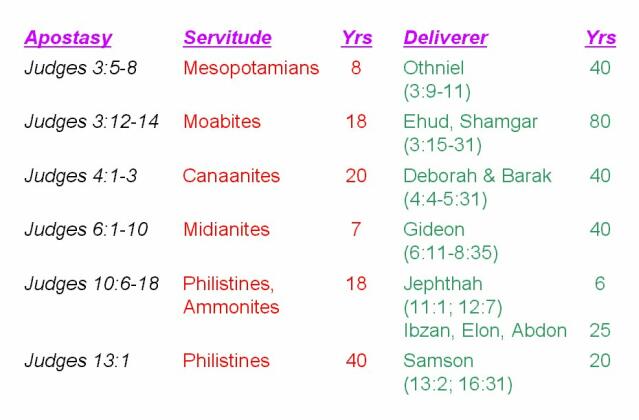
Ñ This section begins with a flashback to Joshua and his generation that entered the promised land. It provides the background for the six cycles that appear in this book. Each cycle consists of four parts: - Sin “… the sons of Israel did what was evil in the sight of the Lord …” - Suffering “ … the sons of Israel served [foreign ruler] …” - Supplication “… the sons of Israel cried to the Lord …” - Salvation “… the Lord raised up a deliverer …” Ñ The following table shows the six cycles: [6] Click on the above table for a larger view |
|
|
s What might be some reasons that the next generation after Joshua did not know the Lord (2:10)? s What made the Lord angry (2:11-13)? s What did God do as a result of His anger? |
|
|
( “The gods have not changed, for human nature has not changed, and these are the gods that humanity regularly re-creates for itself. What does it want? If it is modest, security and comfort and reasonable enjoyment; if ambitious, power and wealth and unbridled self-indulgence. In every age there are forces at work which promise to meet our desires – political programmes, economic theories, philosophical movements, entertainment industries – all having one feature in common: they are big enough to do things for us that we cannot do for ourselves, yet at the same time amenable to our manipulating them so as to get from them what we want. … We put our money into this one, and vote for that one, and spend all our free time on the other one, expecting worldly benefits to be produced by human efforts.” [7] s
What was the role of the “judges”? ( “The relationship of the people in every generation to their Creator has affected their conduct and their relationships to their fellowmen.” [8] © Who are some examples of people that we rely upon as “judges”? Ñ Notice which judges are given a prominent place in the believers’ “hall of fame” in Hebrews 11:32. It is interesting that Barak is mentioned while Deborah is not. s Why did God allow the other nations to remain (2:21-23)? - Because Israel had forsaken the covenant - In order to test Israel’s faithfulness © Do you think that the Lord tests you in areas that you might be tempted to be unfaithful? ©
What are some “thorns” that God allows to remain in your life? |

|
|
ÿ God wants to be our Deliverer and give us success. ÿ God doesn’t always remove the thorns from our path. |
|
Judges 3:1-11 |
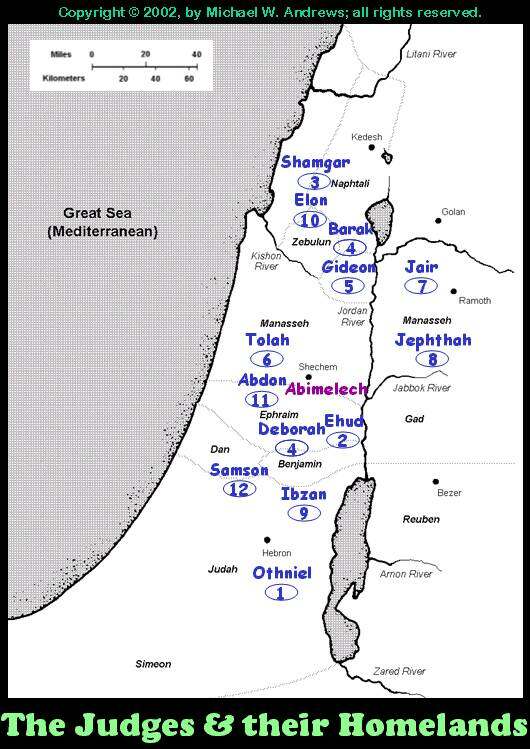
þ Slide 2: Map of the locations of the judges s Why did God allow the other nations to remain? - In order to teach war to Israel - In order to test Israel’s faithfulness s Why did Israel need to learn about war? s
Why wasn’t the promised land a place of rest for them? © Do we need conflict in our lives, too? (
In the northeastern United States codfish are a big
commercial business. Note the following facts: There is a market for eastern
cod all over, especially in sections farthest removed from the northeast
coastline. But the public demand posed a problem to the shippers. At first
they froze the cod, then shipped them elsewhere, but the freeze took away
much of the flavor. So they experimented with shipping them alive, in tanks
of seawater, but that proved even worse. Not only was it more expensive, the
cod still lost its flavor and, in addition, became soft and mushy. The
texture was seriously affected. – Charles Swindoll |
|
|
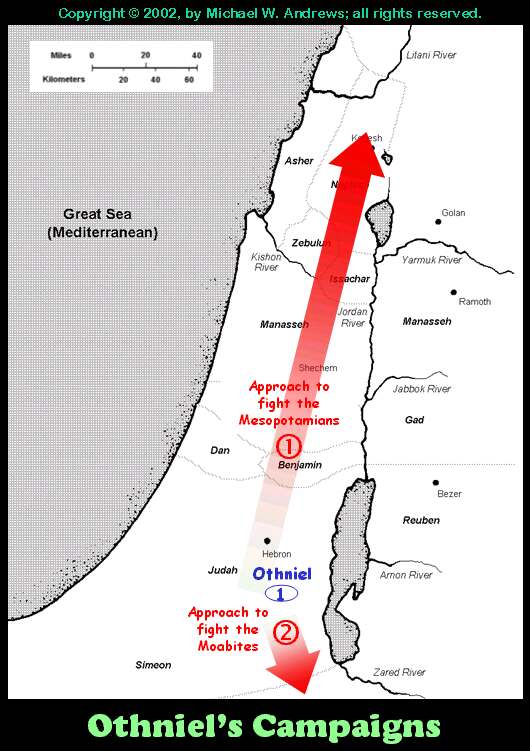
s What was the first nation to subjugate Israel? þ Slide 3: Map of Othniel’s campaigns Ñ The description of the Lord’s anger (3:8) is very expressive: literally, “His nose became hot.” [10] s Why do you suppose that the Lord didn’t deliver Israel until they cried out to Him? |
|
Judges 3:12-30 |
s Who was next to subjugate Israel? Ñ Notice that Israel suffered more than defeat: they lost the “city of palms” (Jericho), which was the first city they had conquered in Canaan. s
What do we know about Ehud? - Your enemy would keep an eye on your right hand in case you decided to attack him, so a left-handed person could deceive an opponent more easily. - Ironically, he was from the tribe of Benjamin, which means “son of the right hand.” In 20:16 we find a whole left-handed fighting force, so apparently Ehud wasn’t alone. - The phrase in 3:15 does not literally say he was left-handed; it states that Ehud had a “bound right hand,” perhaps referring to a physical handicap. [11] Ñ Here is the surprise in this story. Ehud could not use his right hand, so it was assumed that he could not use a weapon at all. This is why the Moabites (and possibly Israel as well, since they didn’t want to start a fight) did not consider him to be a risk. He was a fitting representative of a submissive, conquered people. [12] And perhaps this is how Israel viewed God as well: since He didn’t act the way they wanted, it may have appeared that He could not act at all. Ehud and God both had more ability than Israel expected. Read 1 Cor.1:26-29. s What impact did their king’s death have on the Moabites? s What do these nations teach us about depending upon a king? ©
The Moabites had no direction when they lost Eglon. Do you
depend on anything so much that its loss would throw your life into disarray? |
|
Judges 3:31 |
Ñ Shamgar was a mighty man who slew 600 Philistines! All we know about him is from this verse and also 5:6-7. s What does 5:6-7 suggest about the conditions under which Shamgar was judge? s
Shamgar’s name may not be Hebrew, since it is found several
times in Mesopotamian writings. [13] So that poses a question: Do you think God would
use a Canaanite to serve His purposes in delivering Israel? |

|
|
ÿ Our trials cause us to choose a master, and so they ought to draw us nearer to the Lord. ÿ God is a more reliable King than any person or thing that we might establish. |
|
|
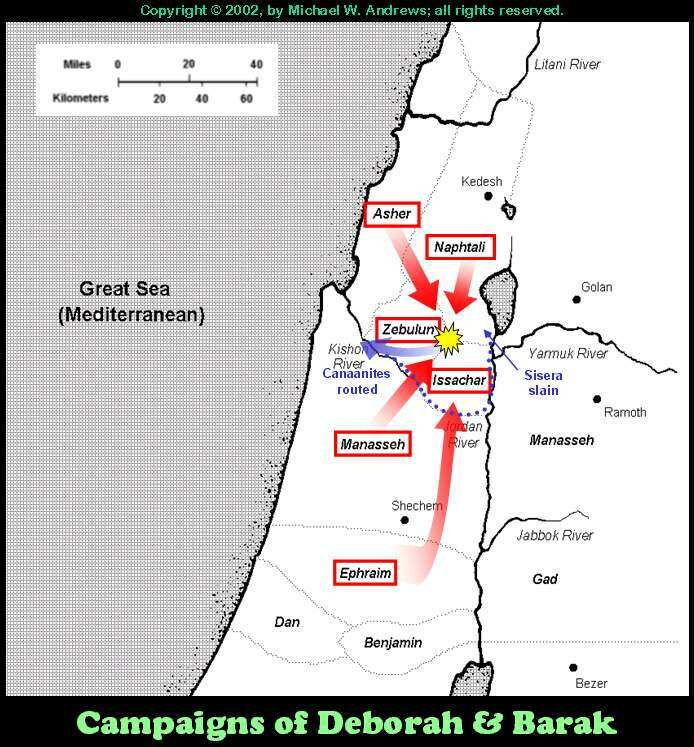
þ Slide 2: Map of the locations of the judges Ñ Deborah’s Hebrew name means “honeybee.” [14] Ñ Hazor had been previously destroyed by Joshua (Josh.11). Like Jericho (3:13), the Lord allows Hazor to once again become a threat to Israel. s Why do you suppose the “iron chariots” were such a problem for the Israelites (compare 1:19)? ( “[This is] one of the major cultural turning-points of history, as the whole way of life of the Bronze Age yields to the superior technology of the Iron Age.” [15] s What was the message from the Lord that Deborah gave Barak? s Why did Barak insist that Deborah go to the battle (4:8)? s Does Barak’s request suggest that he is cowardly (evading responsibility) or faithful (trusting only in God’s words through His prophetess)? s Why do you suppose that Barak is mentioned in Heb.11:32 but Deborah is not? - Perhaps Barak’s faith is found in his insistence to have God’s presence (in Deborah the prophetess) nearby. In this way his response would be much like that of Moses (Exod.33:12-17). [16] - Perhaps Barak exhibits faith in his willingness to go to battle knowing that he will receive no credit for the victory. s Which tribes of Israel were involved in this campaign? þ Slide 4: Map of the campaigns of Deborah & Barak |
|
Judges 4:11-23 |
s
What does this story teach us about those who command armies? ©
Where (or from whom) do you get your directions each day? |
|
|
Ñ Notice the similarities between the assassination of Eglon (3:15-25) and the assassination of Sisera. Each was done in private, to an unsuspecting person, and by deception. [17] |
|
Judges 5:1-11 |
The Song of Deborah and Barak Praise for Commanders s List all those for whom Deborah is grateful. - God - The leaders in Israel - The people to volunteered to fight s How does Deborah describe the Lord going to battle? s What was the situation like before Deborah became a judge? - The people followed other gods - War pressed upon Israel’s own cities - But Israel wasn’t motivated to fight - Highways were deserted (no travel or commerce) - Villages were lifeless |
|
Judges 5:12-23 |
Praise for Volunteers s Which tribes volunteered to help and which ones stayed away? Ñ Notice that the stars and the river Kishon are viewed as assisting Israel in the battle. Deborah understood the Lord to be calling upon heaven and earth to defeat the enemy. © Which battles does God want you to join, but you prefer to stay out of? © When have you been like Reuben and missed opportunities because of indecision? Ñ Some think that Meroz was a village 12 miles from Samaria.[18] The inhabitants apparently refused the Lord’s call to help in the battle (5:23). |
|
Judges 5:24-27 |
Blessings for Unexpected Help s Why is Jael blessed in this song? Ñ The blessing of Jael should be contrasted with the condemning of Meroz. Some who were expected to support Israel refused, and some (like Jael) who were expected to support the enemy did not. |
|
Judges 5:28-31 |
Mourning for the Lord’s Enemies s What was the mother of Sisera (the Canaanite commander) thinking? s Who are the “Lord’s enemies” (5:31) in this song? |

|
|
ÿ God’s message to His people will always prevail over the forces that oppose Him. ÿ God leads an army of His followers. |
|
Judges 6:1-10 |
Ñ The Midianites were half-brothers to the Hebrews, since Midian was a son of Abraham by his last wife, Keturah (Gen.25:1-6). Moses lived among them for forty years and married the daughter of the priest of Midian. The boundaries of Midian are never clearly specified and their people seem to have wandered into many areas. [19] s Describe the way that the Midianites devastated Israel. - Drove them out of their homes - Attacked at sowing time (which prevented planting) - Ravaged the land with their huge encampments ( “It is no coincidence that innumerable Midianites are sent as a punishment for the rejection of innumerable mercies.” [20] s Why does God remind Israel who He is (6:8-10)? |
|
Judges 6:11-24 |
Ñ Under normal circumstances, it would have been ludicrous to thresh wheat in the closed shelter of a wine press (6:11). Threshing is usually done on a flat place where breezes can blow away the chaff, but Gideon needed to hide his harvest from the Midianites. [21] s
What was Gideon’s complaint (6:13)? s How did God answer Gideon’s complaint (6:14)? ©
What is your most recent complaint about the Lord’s “absence”? s What was Gideon’s concern about being chosen as a leader (6:15)? s How did the angel of the Lord prove who he was (6:19-24)? Ñ Notice the significant parallels between Gideon and Moses: [22] - Misery of Israel Exodus 2:23 Judges 6:6 - Conversation with the Lord Exodus 3:10-12 Judges 6:11-22 - Confirming sign Exodus 3:12 Judges 6:17 |
|
Judges 6:25-32 |
Delivering the City s Why do you suppose Gideon was first commanded to remove the altar to Baal in his own town (rather than going out and attacking the Midianites)? - To test his obedience - To exhibit his faith in the real God - To remove the obstacle that prevented God from helping the people |
|
|
© What would the Lord tell Gideon to destroy today? What are some examples of “altars” where people devote themselves instead of pursuing a relationship with God? s What do you think Gideon was feeling as he destroyed the altar and the “asherah”? |
|
|
Ñ The people of the town were understandably upset, but notice that Gideon’s father, Joash, seems to be more rational about the situation. And Joash was the one responsible for the altar (6:25), so it is even more remarkable. s What is Joash’s wisdom concerning Baal’s defense? © Are there practices in the church that we would rather defend ourselves than allow God to handle? |
|
Judges 6:33-40 |
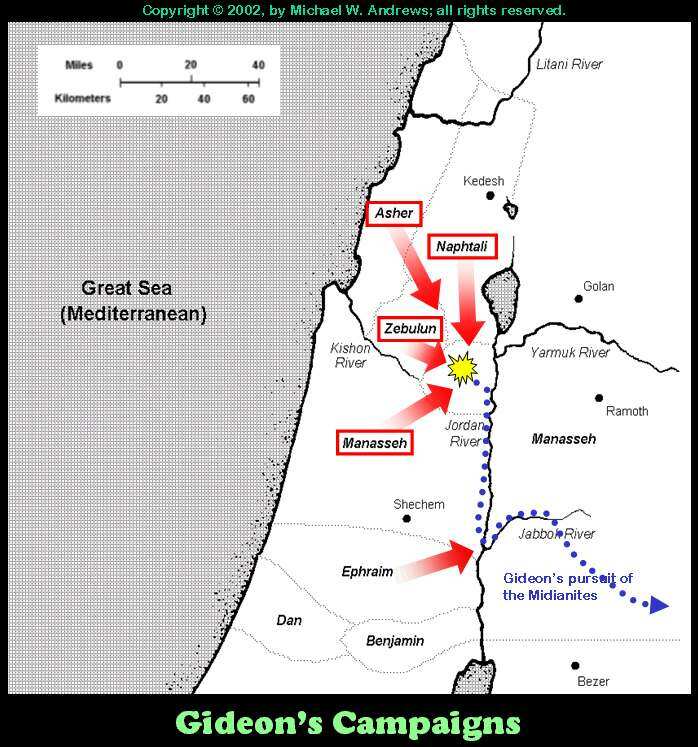
Delivering the Nation Ñ Notice first that there appear to have been no further repercussions concerning Gideon’s previous actions. In fact, it seems to have established him as a credible leader! Ñ The phrase stating that “the Spirit of the Lord came upon Gideon” (6:34 NAS) literally explains, “the Spirit of the Lord clothed Himself with Gideon.” Few metaphors better ft the “filling” of the servant of God for Spirit-inspired leadership than this one. [23] s Which tribes are involved in this confrontation? þ Slide 5: Map of Gideon’s campaigns s Why do you suppose Gideon was so intent on getting confirmation from the Lord (with two tests rather than one)? © Do you ever ask the Lord to confirm His will for you? What methods have you used? How has the Lord answered? |
|
Judges 7:1-8 |
s Why did the Lord want fewer soldiers? |
|
|
Ñ Although we might like to understand how one’s method of drinking might exhibit one’s ability as a warrior, this would miss the point. The 300 are not intended to be an elite troop, but a group so inadequate that the victory will obviously be credited to God. [24] Perhaps the greater lesson is found in the name of the place where the selection was made: “Harod Spring” could be literally translated “Trembling Spring” (7:1). [25] Imagine being one of those chosen at the spring and watching while most of the strongest warriors were dismissed; certainly you wouldn’t be feeling like the odds were in your favor against an enemy that filled the valley below. s Can you think of examples in which the Lord has performed great deeds with small groups of people? © How can the Lord use a small group that you are part of (perhaps a church or a prayer group) to tackle a big assignment? |
|
Judges 7:9-14 |
s
What was Gideon feeling after the Lord reduced the army to 300
men? |
|
Judges 7:15-23 |
s What was Gideon feeling after hearing the about the dream? s
Describe the method of attack used by Gideon’s army. - Timed to take place at the change of the watch - Blew trumpets - Smashed pitchers - Held torches - Shouted - Stood in their places - The Midianites killed each other - The Midianites fled in fear |
|
Judges 7:24 -8:3 |
s What were the men from Ephraim so upset about (8:1)? © Can you think of times that we complain about the protocol instead of praising God for His actions? s How did Gideon handle this potential conflict? © How can you apply this model to resolve a conflict in your life? |
|
Judges 8:4-21 |
s Why did the people of Succoth refuse to help Gideon’s army? - It would have been hard to believe that such a small army had routed the innumerable Midianites s What were the consequences of their decision? s How should the people of Succoth have sought assurance that Gideon would be the victor? |
|
|
Ñ The story takes a startling twist in 8:18-19 as the Midianite kings are put to death. Gideon explains that Zebah and Zalmunna were responsible for the death of his brothers. Thus we see that Gideon’s ruthless determination was motivated (at least in part) by a personal vendetta! [26] We must always be cautious about using God’s gifts for our own purposes. |

|
|
ÿ
God uses the weaknesses of people to display his mighty
strength. ÿ God does great things with small groups of people. ÿ God drives out our fear, but may use fear to route His enemies. |
|
Judges 8:22-35 |
s Why did Israel want a ruler (8:22)? s
Why do you suppose Gideon refused? s Why do you think Gideon collected the gold and had an ephod made? s How was the ephod used? ©
Are there memories or results of God’s actions in your life
that you’ve held onto a little too tightly? |
|
Judges 9:1-6 |
Ñ Although the Shechemite people in this story belong neither to Israel nor to Israel’s enemies [27], the place had been important to God’s people for hundreds of years. Abram built an altar to the Lord at Shechem, near the oak of Moreh, after the Lord promised him the land (Gen.12:6). Shechem was one of the cities of refuge designated by Joshua (Josh.21:21). It was the location of Joshua’s last speech to the people (Josh.24:1), and when they renewed their covenant with the Lord Joshua (Josh.24:24-27), “Joshua made a covenant with the people that day, and made for them a statute and an ordinance in Shechem. And Joshua wrote these words in the book of the law of God; and he took a large stone and set it up there under the oak that was by the sanctuary of the LORD. And Joshua said to all the |